
2017

A HSC-SSP image of a galaxy cluster (Image NAOJ/HSC Project)

At the end of February the first data from the Hyper Suprime-Cam Subaru Strategic Program (HSC-SSP) were released to the public. It’s a kind of cosmic census created using a large digital camera installed on the Subaru Telescope. The National Astronomical Observatory of Japan (NAOJ) developed a dedicated database and interface to use the wealth of data collected. One hope is to be closer to understand the fate of the universe.

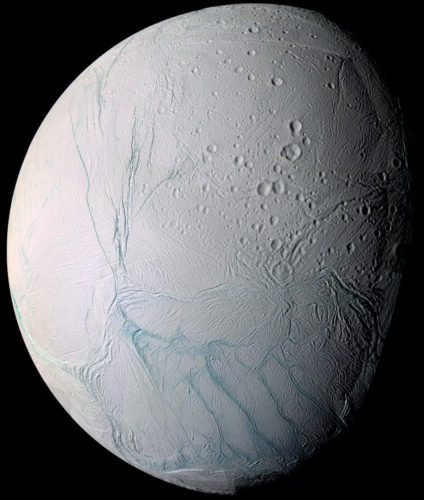
Enceladus with some tiger stripes in blue (Image NASA/JPL/Space Science Institute)

An article published in the journal “Nature Astronomy” describes the discovery that the south pole of Enceladus, one of the planet Saturn’s moons, is warmer than expected under the icy surface. A team of researchers led by Alice Le Gall of LATMOS and UVSQ studied detections carried out by the Cassini space probe during a flyby in 2011 concluding that the underground ocean on Enceladus is closer to the surface than previously thought.

Illustration of Fermi Bubbles and the use of quasars to study them (Image NASA, ESA, and Z. Levy (STScI))

An article published in “The Astrophysical Journal” describes a research on one of the giant gas bubbles regurgitated by the supermassive black hole at the center of the Milky Way. Called Fermi bubble, it’s a type of structure still not well understood and a team led by Rongmon Bordoloi of MIT used the Hubble Space Telescope to change that measuring various characteristics of the gas inside the bubble.

The great bright spot at the center of Occator crater (Image NASA/JPL-Caltech/UCLA/MPS/DLR/IDA/PSI/LPI)

An article published in the journal “Astronomical Journal” describes a study that provides a dating to the large bright spot in Occator crater on the dwarf planet Ceres. A team of researchers led by Andreas Nathues of the Max Planck Institute for Solar System Research (MPS) in Göttingen, Germany, used data collected by NASA’s Dawn space probe to analyze the interior of Occator concluding that the bright spot is 4 million years old, 30 million less of the crater.

Artistic concept of the galaxy A2744_YD4 (Image ESO/M. Kornmesser)

An article to be published in the journal “The Astrophysical Journal Letters” describes a research about the galaxy A2744_YD4, the most distant observed with the ALMA radio telescope. A team of astronomers led by Nicolas Laporte of University College London also used the X-shooter instrument on ESO’s VLT to confirm that we’re seeing A2744_YD4 as it was about six hundred million years after the Big Bang. The most interesting thing is the dust detection indicating that there were already several supernovae.