2017

Mars north pole (Image ESA/DLR/FU Berlin, CC BY-SA 3.0 IGO)

ESA has published an image of Mars’ northern polar cap. It’s the composition of 32 images captured by the the Mars Express space probe’s High Resolution Stereo Camera (HRSC) instrument during as many passages above Mars’ north pole between 2004 and 2010. That mosaic shows the polar cap’s spiral-shaped troughs.

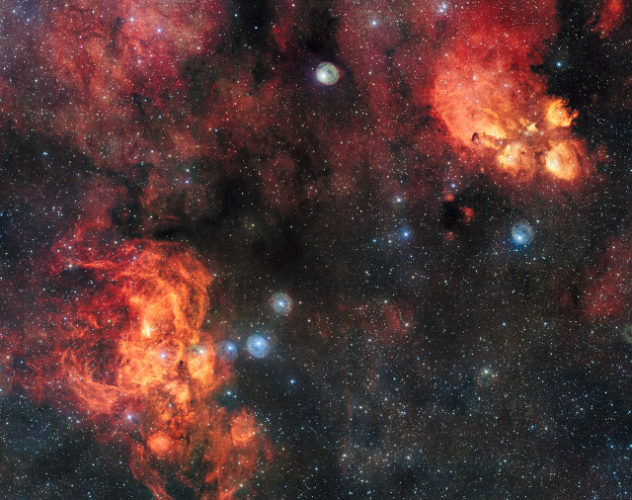
NGC 6334 and NGC 6357 (Image ESO)

ESO has released one of the largest astronomical images created thanks to the VST (Very Large Telescope Survey Telescope) which includes two cosmic clouds of gas and dust, NGC 6334 and NGC 6357. Because of their shapes, they’re also known respectively with their popular names as the “Cat’s Paw Nebula” and the “Lobster Nebula”.

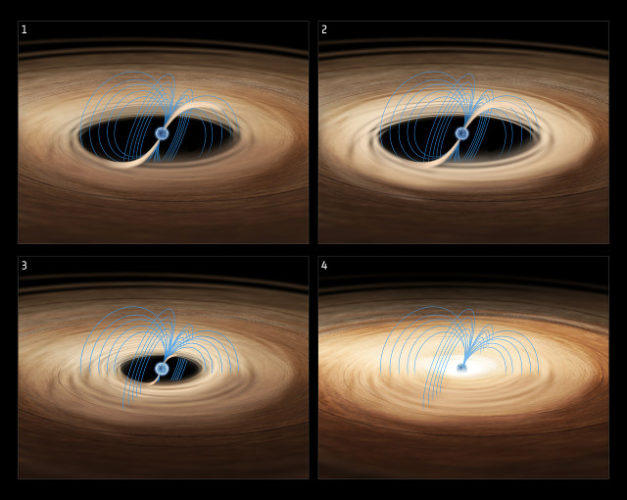
Artist's impression of Rapid Burster (Image ESA/ATG medialab)

An article published in the journal “Monthly Notices of the Royal Astronomical Society” describes a research that provides an explanation for an astronomical mystery dating back to the 1970s. A team of researchers of the Anton Pannekoek Institute for Astronomy in Amsterdam led by Jakob van den Eijnden discovered a gap in the accretion disk of the binary system MXB 1730-335, known as Rapid Burster for its rapid and discontinuous X-ray flashes.

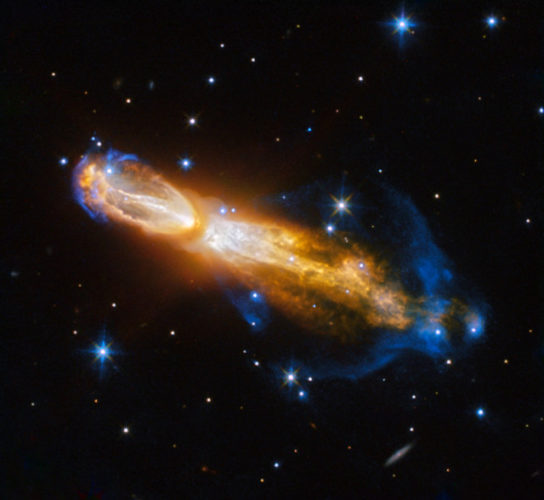
The Calabash Nebula (Image ESA/Hubble & NASA. Acknowledgement: Judy Schmidt)

A photograph taken by the Hubble Space Telescope shows the Calabash Nebula, a protoplanetary nebula showing the agony of a low-mass star like the Sun. This nebula is also known by the nickname Rotten Egg Nebula because its study revealed that in the gas surrounding it there’s a high concentration of sulfur, the element that causes the characteristic rotten egg smell.

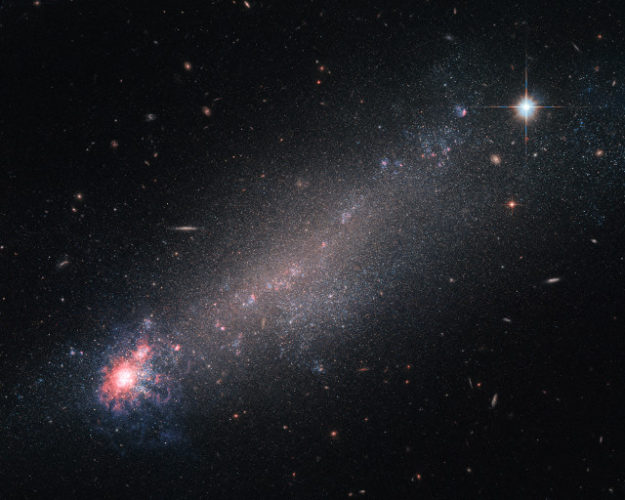
NGC 4861 (Image ESA/Hubble & NASA)

A team of researchers proposed an explanation for the strange appearance of the galaxy NGC 4861, which has the characteristics of a barred spiral galaxy but it looks more like a dwarf irregular galaxy. It’s possible that there’s an ongoing production of charged particle jets during a star formation phase with the generation of galactic winds that explain the strange shape of NGC 4861, similar to a comet.