2017

Wright Mons on Pluto (Image NASA/JHUAPL/SwRI)

An article published in the journal “Icarus” describes a research that suggests new possibilities for the gravitational effects of trans-Neptunian celestial bodies to generate heat on other celestial bodies close enough such as in the case of Pluto and Charon. A team of researchers examined the influence of that type of heating on bodies that may have very low temperatures but that under certain conditions can host underground oceans whose duration could be lengthened.

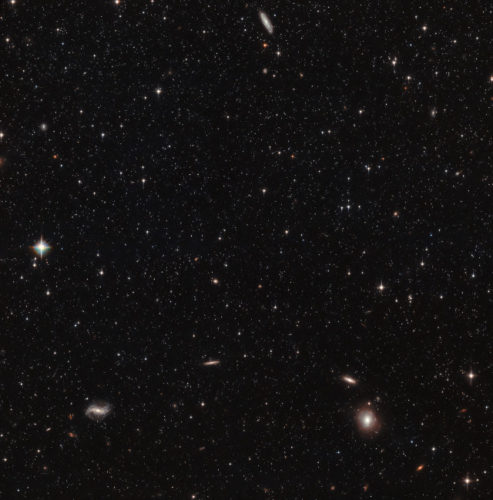
Hubble Ultra Deep Field galaxies seen by MUSE (Image ESO/MUSE HUDF collaboration)

A series of 10 articles to be published in the journal “Astronomy & Astrophysics” describes various aspects of the deepest spectroscopic investigation ever carried out with the MUSE instrument installed on ESO’s Very Large Telescope (VLT) in Chile. An international team with many researchers focused on the Hubble Space Telescope’s Ultra Deep Field (HUDF) to measure distances and properties of 1,600 very dim galaxies, of which 72 were never detected before.

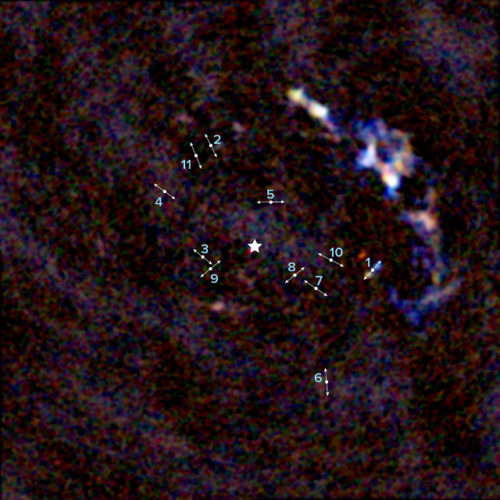
The protostars detected by ALMA (Image ALMA (ESO/NAOJ/NRAO), Yusef-Zadeh et al.; B. Saxton (NRAO/AUI/NSF))

An article published in the “Astrophysical Journal Letters” describes the discovery of protostars near the center of the Milky Way, near the supermassive black hole known as Sagittarius A* (or Sgr A*). A team of astronomers made this discovery using the ALMA radio telescope, a surprising result because the conditions in that area were considered too hostile due to the gravitational tides caused by Sgr A* and the intense electromagnetic emissions from the heated gas and dust ring around it.

A part of the Sculptor Dwarf Galaxy (Image ESA/Hubble & NASA)

An article published in the journal “Nature Astronomy” reports the reconstruction of the 3D movements of 10 stars in the Sculptor Dwarf Galaxy selected within a larger sample of over 100 among those with the smallest measurement errors. A team of researchers used observations made using the Hubble Space Telescope in 2002 and subsequent observations carried out by ESA’s Gaia space probe between 2014 and 2015 to produce this reconstruction that confirms the “cold” dark matter model.

Representation of neutrinos reaching IceCube (Image courtesy IceCube Collaboration)

An article published in the journal “Nature” describes the measurement of the probability that neutrinos will be absorbed by Earth depending on their energy and the amount of matter they pass through. The researchers of the IceCube Collaboration used the neutrino detector in Antarctica to better understand the behavior of these elusive particles.