2017

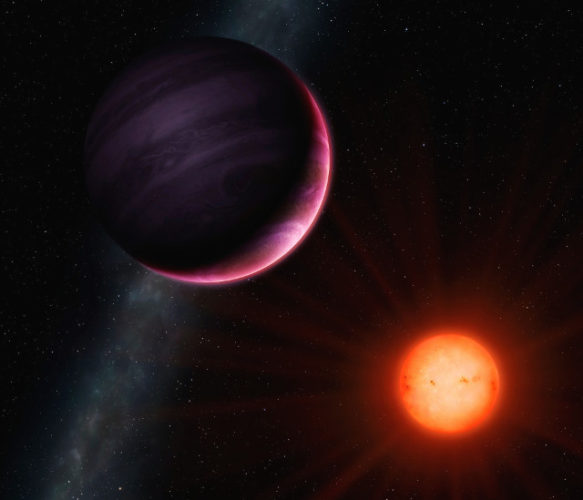
Artist's impression of the planet NGTS-1b and its star (Image University of Warwick/Mark Garlick)

An article published in the magazine “Monthly Notices of the Royal Astronomical Society” describes the discovery of a hot Jupiter-type gas giant planet orbiting the star NGTS-1, a red dwarf. This is an extraordinary pair that’s in conflict with the current planetary formation models. The exoplanet NGTS-1b is the first to be discovered with the new Next Generation Transit Survey (NGTS) instrument installed at ESO’s Paranal Observatory in Chile.

Aurora at Jupiter's North Pole (Image NASA / ESA / J. Nichols (University of Leicester))

An article published in the journal “Nature Astronomy” describes a research on the auroras on the planet Jupiter. A team of researchers used ESA’s XMM-Newton and NASA’s Chandra space telescopes to observe the pulsations of Jovian auroras. The study shows that the auroras pulsate independently at the two poles, unlike what happens on Earth.

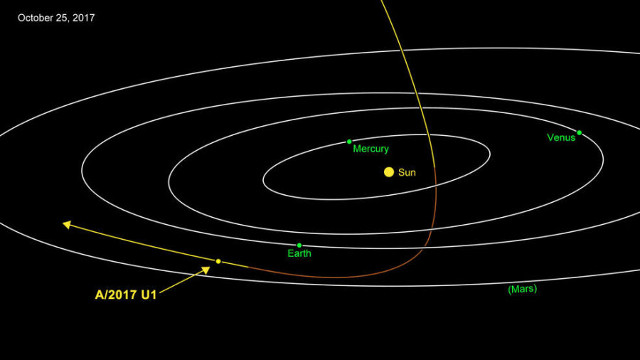
A/2017 U1's trajectory through the solar system (Image NASA/JPL-Caltech)

The announcement of the discovery of a possible asteroid coming from another solar system is a big deal. Named as A/2017 U1, it was detected on October 19 by the Pan-STARRS 1 telescope in Hawaii, part of a sky observation system normally used to detect celestial bodies of various kinds. Its motion seems incompatible with the trajectories of asteroids and comets gravitationally bound to the Sun so it could be the first celestial body discovered that came from another star, perhaps Vega.

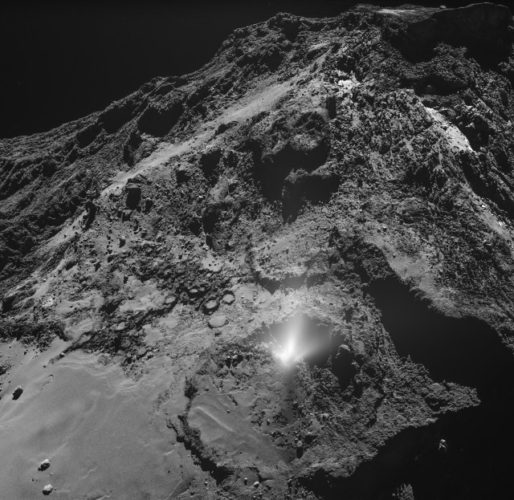
Plume on comet 67P/Churyumov-Gerasimenko (Image ESA/Rosetta/MPS for OSIRIS Team MPS/UPD/LAM/IAA/SSO/INTA/UPM/DASP/IDA)

Two articles published in the journal “Monthly Notices of the Royal Astronomical Society” describe two researches on comet 67P/Churyumov-Gerasimenko based on data collected by ESA’s Rosetta space probe. In an article, a team led by Jürgen Blum of the Technische Universität Braunschweig, Germany, used the data collected to find out how the comet formed. In the other article, a team led by Jessica Agarwal of the Max Planck Institute for Solar System Research in Göttingen, Germany, described a plume on the surface of the comet that could have been generated by pressurized underground gas or by the crystallization of amorphous water ice.

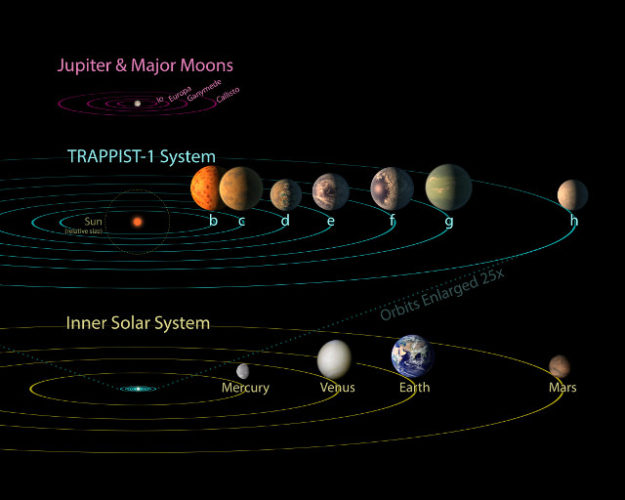
Jupiter and its big moons, the TRAPPIST-1 system and the solar system (Image NASA/JPL-Caltech)

An article published in the journal “Nature Astronomy” describes a research on the magnetic field of the star TRAPPIST-1 and its possible consequences on its inner planets. According to a team of researchers led by the Space Research Institute (IWF) of the Austrian Academy of Sciences (Öaw) at least two of those planets could be heated by the effects of that magnetic field to the point of having a surface composed of a magma ocean.