
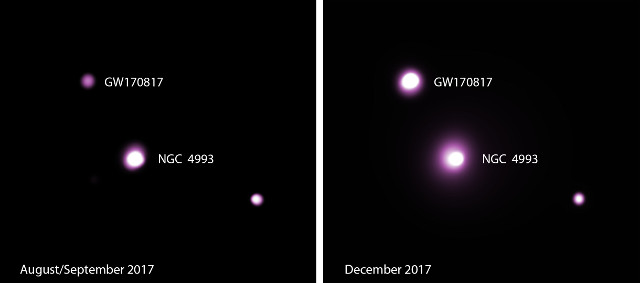
An article published in the journal “Astrophysical Journal Letters” describes the analysis of the observations of the afterglow from the merger of two neutron stars detected last August and announced in October. A team of researchers used NASA’s Chandra X-ray observatory to study the consequences of that event noting that the glow continued, indicating that the gamma-ray burst generated from that collision is more complex than the scientists initially thought.
The event indicated with as GW170817, with the observation of the merger of two neutron stars at both gravitational waves and electromagnetic waves was extraordinary for the scientific importance that can be fully appreciated only in the long term, with the development of a new branch of astronomy and astrophysics. Not surprisingly, its study saw the involvement of several scientific agencies and organizations at global level showing the very best of science.
The event GW170817 caused an explosion called kilonova, also observed by various telescopes offering various surprises because among other things generated a gamma-ray burst indicated as GRB 170817A that shows characteristics out of the ordinary. Various observations of X-rays and radio waves suggested that after the kilonova a cocoon was generated but for a certain period it wasn’t possible to observe those X-ray emissions because that area of the sky was too close to the Sun.
After a period of about 3 months in which it was possible to detect only radio emissions, at the beginning of December 2017 the source of emissions came out of the blind spot in the sky. At that point, the Chandra space observatory resumed the detection of the X-rays emitted and it turned out that the glow was more intense than before.
The emissions, including the radio waves detected by various radio telescopes, are compatible with the cocoon model but the researchers leave other possibilities open. They think that it’s important that the ongoing monitoring with Chandra continues to understand the evolution of the emissions at the frequencies detected by that space observatory to obtain more complete information.
In essence, it’s possible that the latest studies on these events are on the right track in the search for the explanation of what’s happening under their eyes but there are still unclear points. That’s not surprising considering that it’s the first time that this type of event is observed and until recently the kilonova was a theoretical concept.
