June 2018

The Soyuz MS-09 spacecraft approaching the International Space Station (Image NASA TV)

A little while ago the Soyuz MS-09 spacecraft, which blasted off about two days ago from the Baikonur Cosmodrome in Kazakhstan, has reached the International Space Station carrying three new crew members. The astronauts Serena Auñón-Chancellor of NASA and Alexander Gerst of ESA and the cosmonaut Sergey Prokopyev of Roscosmos now complete the Expedition 55 crew.

The Mars Rover Curiosity and two elements found (Image NASA/GSFC)

In a press conference, NASA announced the latest discoveries on the planet Mars obtained thanks to the analyzes carried out by the Mars Rover Curiosity. In some new samples taken at two sites of Gale Crater, various organic compounds were detected. The methane measurements in Mars atmosphere indicate a seasonal cycle in which its amount varies. These findings have been described in detail in two articles published in the journal “Science”.

The inside of MiniBooNE (Photo Fred Ullrich of Fermilab)

An article published on the arXiv server describes the observation of an excess of electron neutrinos detected by FermiLab’s MiniBooNE experiment. The results are consistent with regard to energy and order of magnitude with those obtained in the 1990s by the LSND experiment in Los Alamos. The most likely explanation is that it’s a proof of the existence of the sterile neutrino, a type of neutrino hypothesized but at least so far not found despite a lot of targeted research.

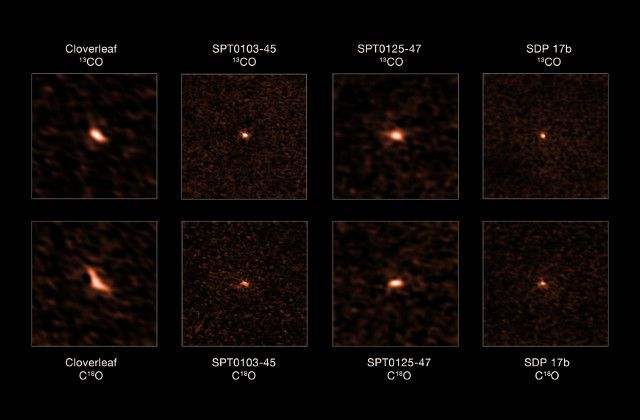
Carbon monoxide in starburst galaxies

An article published in the journal “Nature” describes the discovery of star formation regions where the percentage of massive stars is much higher compared to others. A team of astronomers led by Zhi-Yu Zhang of the University of Edinburgh used the ALMA radio telescope to study four very old dusty galaxies of the starburst type, meaning where there’s a high star formation rate.