
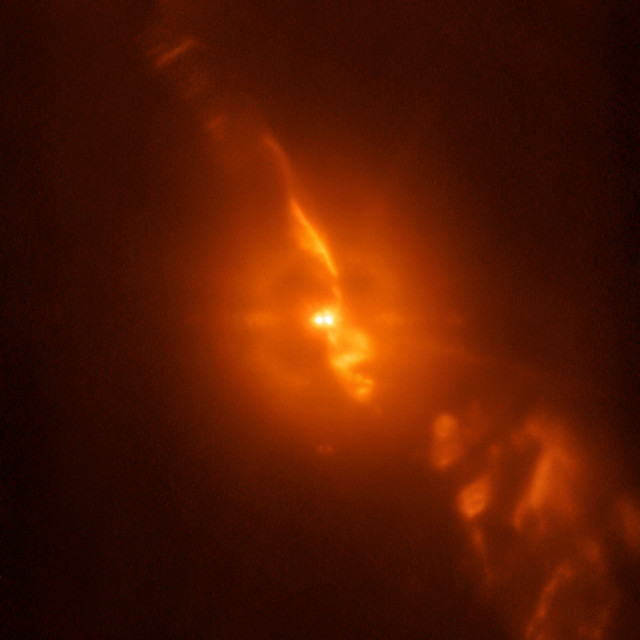
An article published in the journal “Astronomy & Astrophysics” describes a new observation of the R Aquarii binary system, consisting of a red giant of the type called Mira variable and a white dwarf. A team of researchers used that pair of stars as a target for a test of a new subsystem of the SPHERE instrument mounted on ESO’s VLT obtaining the clearest image captured so far of the turbulence existing in the system due to the fact that the white dwarf is stealing gas from its companion, worsening its agony.
The R Aquarii system is about 650 light years away from Earth so it’s close in astronomical terms, consequently it’s one of the closest symbiotic binary systems, the ones in which there’s a relationship of the same type as in the two stars that form this pair. In this case the red giant is a Mira Variable, which means of the pulsating type that have a pulsation period longer than 100 days and a certain level of variation in its brightness. However, it’s not visible to the naked eye though you don’t need powerful instruments to be able to spot it.
Thanks to its characteristics, the R Aquarii system has been the subject of several studies over time with a series of increasingly sophisticated instruments, including the VLT (Very Large Telescope). For these new observations they used the Zurich IMaging POLarimeter (ZIMPOL), a component of the SPHERE instrument, activated in June 2014. It’s mainly used to take direct photos of exoplanets but can also be used to study other types of astronomical objects, in this case a pair of stars.
The observations made with SPHERE/ZIMPOL allowed to obtain details of the R Aquarii system even better than those taken years ago by the Hubble space telescope showing the chaos caused by the relationship between the two stars. Red giants are a phase in the life of medium-mass stars characterized by continuous changes and the proximity of a companion increases their instability.
In its cycle of 387 days for each pulse, the red giant loses large amounts of mass when it swells. Originally it was a star with a mass not much higher than the Sun’s but it’s reaching the end of its life and one day it will become a white dwarf like its companion, which has a mass probably a little lower than the Sun concentrated in a much smaller volume. The consequence is that part of the gas ejected by the red giant is absorbed by the white dwarf and when it accumulates enough it can trigger a nova, which in turn causes the ejection of materials into space.
In such situations, there may be more novae and the nebula surrounding the R Aquarii system is proof that in the past there was at least one event of that kind. There are some candidates among the novae sighted centuries ago, when they were visible to the naked eye, which could be events connected to R Aquarii such as the two sighted in 1073 and 1074 but the research continues.
In a few billion years, the Sun will also become a red giant and then turn into a white dwarf. The two stars of the R Aquarii system have already reached the end of their lives and the SPHERE/ZIMPOL instrument allowed the astronomers to capture details of those processes and the interaction between the two stars never seen before.
