
 A team of astronomers announced the discovery of the celestial body farthest from the Sun within the solar system. Cataloged as 2018 VG18 and nicknamed Farout, it was discovered by astronomers specializing in the search for Kuiper Belt Objects including the one nicknamed The Goblin, announced in October 2018. 2018 VG18 is much further away, currently at a distance from the Sun estimated around 120 times the Earth’s.
Scott Sheppard of the Carnegie Institution for Science and his colleagues Chad Trujillo and David Tholen have been searching for trans-Neptunian objects for years, sometimes even extreme ones as they defined the ones whose perihelion is far beyond Neptune and have a large semi-major axis greater than 150 times the distance between the Earth and the Sun, have perihelion areas close to those objects. Their hypothesis is that in the Kuiper Belt there’s at least one planet but in the meantime they found only smaller objects, with a diameter not exceeding a few hundred kilometers.
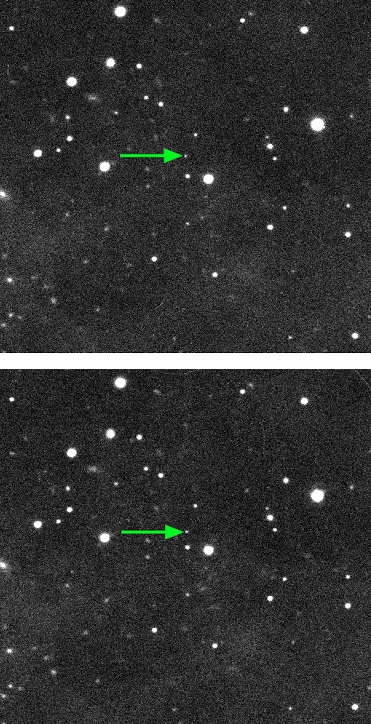
2018 VG18 was discovered in the top images (courtesy Scott S. Sheppard and David Tholen, all rights reserved), taken on November 10, 2018 using the Subaru telescope in Hawaii, just like The Goblin and other items in the Kuiper Belt. The confirmation came at the beginning of December thanks to observations carried out using the Magellan telescope at Carnegie’s Las Campanas Observatory in Chile. The subsequent monitoring of this object, in the meantime nicknamed Farout, allowed to obtain the first estimates of its distance, size and other characteristics even if follow-up studies will be needed for them to be precise.
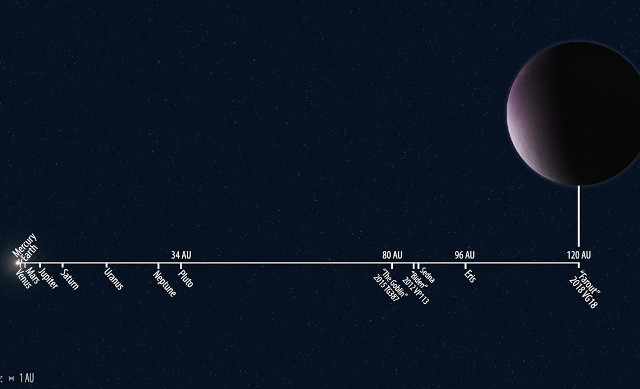
So far, the most distant object from the Sun within the solar system was the dwarf planet Eris, whose distance is currently about 96 times the Earth’s. This means that 2018 VG18 is much further away, the first away from the Sun more than 100 times the Earth, as shown in the bottom image (courtesy Roberto Molar Candanosa/Scott S. Sheppard/Carnegie Institution for Science. All rights reserved). This object is so far away that it’s much slower than Eris and The Goblin not to mention the planets. As a result, it may take years to reconstruct its orbit quite accurately but its year is likely longer than 1,000 Earth years.
The 2018 VG18 orbit problem may not just be a scientific curiosity but it could also be useful to understand if in that area of the solar system there’s really another planet. So far, a number of researches based on simulations that considered the orbits of different objects provided very different estimates of the characteristics of the alleged Planet X (or Planet 9). Chad Trujillo and his colleagues hypothesized that it’s currently so far from the Sun that even the most powerful telescopes can’t detect it. It seems much easier to discover smaller but less distant objects and each of them provides new information that can confirm or deny the various hypotheses.
The observations of 2018 VG18 suggest that its diameter is around 500 kilometers so it could be a dwarf planet with a shape close to a sphere. It has a pinkish color that’s generally associated with ice-rich objects. In the Kuiper Belt and even more in the Oort Cloud, an area of the solar system even farther away, there could be enormous amounts of comets but also many larger objects containing lots of frozen water and only in the last few years we’re beginning to discover them.
Perhaps the discovery of 2018 VG18 will not offer answers about the presence of one or more planets in the Kuiper Belt but it’s still interesting. As with the objects discovered previously, it’s now possible to conduct follow-up observations to obtain more information, also on the amount of ice water present, connected to the broader research on the presence of water in space.

Permalink