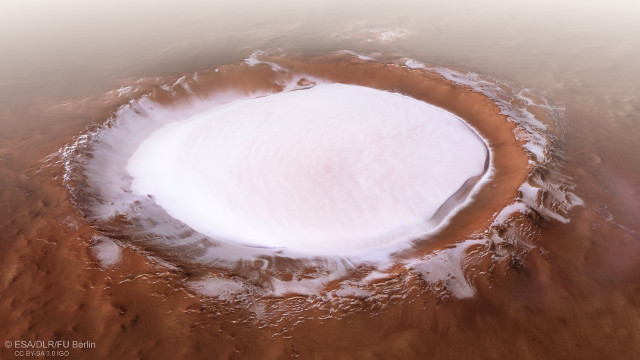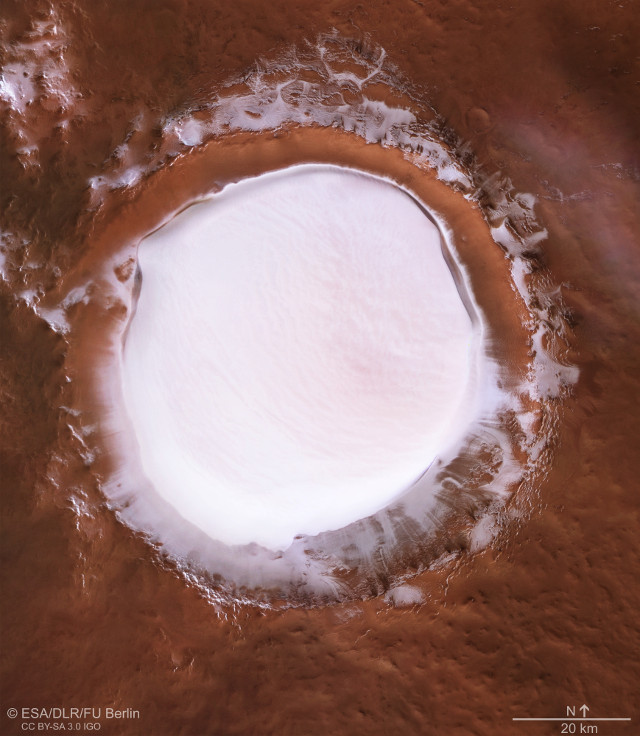
ESA has published new images of Korolev crater on Mars obtained thanks to of its Mars Express space probe’s High Resolution Stereo Camera (HRSC) instrument. Its peculiarity is that it’s filled with water ice and despite the presence of dust its color is white, which is a strong contrast with that of the surrounding land. Normally water can’t remain solid at the very low pressure generated by the Martian atmosphere but near the north pole Korolev crater acts like a cold trap.
Korolev crater is named after Sergei Pavlovich Korolev (the transliterations from the Cyrillic can vary), the father of the Soviet space program, whose developments are still used today by the Russians. For a certain period he was imprisoned in a gulag following accusations of sabotage and during the terrible Stalinist purges that wasn’t even the worst that could happen but the work slowed down considerably without him and after a few years he was reinstated into his job. His identity was kept secret until after his death, which perhaps marked the defeat of the Soviets in the race to the Moon, but today many honors are dedicated to him including this crater on Mars.
Near the area called Olympia Undae, which surrounds part of Mars’ northern polar ice cap, Korolev crater has a diameter of almost 82 kilometers. This means that it’s not particularly large for Martian standards but is almost completely full of ice as the cap is about 60 kilometers wide and its depth reaches about 2 kilometers while the ice sheet reaches about 1.8 kilometers of height. It’s a perennial glacier because the crater’s depression acts as a cold trap in which the air moving over the ice cools and falls down, creating a layer of air that acts as an insulator while keeping the water stably in its solid state.
Cold traps can be very effective in keeping temperatures at very low levels in certain places, so much so that even on the dwarf planet Ceres and on the Moon, where the atmosphere is extremely thin, water ice was identified on their surface or at no more than a few millimeters of depth. A number of studies produced results of this type, the most recent concerning the Moon was described in an article published in the journal “Proceedings of the National Academy of Sciences” in August 2018.
Korolev crater isn’t the only one on Mars to be full of water ice but there are others where cold traps generated glaciers. There’s an example still in the northern area, even if a little farther away from the north pole, with Louth crater, which is much smaller with a cap about 12 kilometers in diameter. Because of its size and the amount of ice inside it, Korolev is the most interesting crater of this type, so it’s been observed several times by the Mars Express space probe, which over the years has taken several photos that have now been assembled in the images published. It’s also a celebration of the 15th anniversary of Mars Express entering Mars orbit, which took place on December 25, 2003.