2018

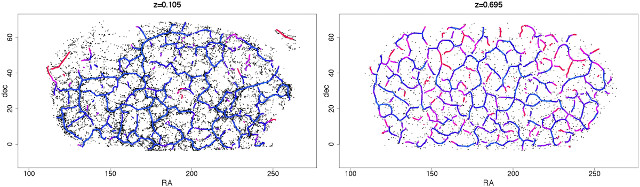
The cosmic web in two moments

An article published in the journal “Nature Astronomy” describes the creation of a map of the network of filaments that connects matter all around the universe. A team of researchers analyzed the data collected during previous surveys to find the gravitational effects that reveal the shapes of those filaments. Those small gravitational distortions suggest that they’re hundreds of millions of light years long and that they’re made of dark matter.

An infrared 3-D image of Jupiter's North Pole (Image NASA/JPL-Caltech/SwRI/ASI/INAF/JIRAM)

During the general assembly of the European Geosciences Union General Assembly in Vienna, scientists of NASA’s Juno mission showed a 3D map that reproduces cyclones and anticyclones in the planet Jupiter’s polar regions. In particular, they created an animation of a flight over the North Pole. Using data collected by the Juno space probe they were also able to create the first detailed view of the dynamo that powers the planet’s magnetic field.

Star systems observed by the SPHERE instrument (Image ESO/H. Avenhaus et al./E. Sissa et al./DARTT-S and SHINE collaborations)

Two articles, one published in the “Astrophysical Journal” and one in “Astronomy & Astrophysics”, describe two researches on a number of star systems. Two teams used the SPHERE instrument mounted on ESO’s VLT in one case to study dust and gas disks around a number of young stars in their formation stage and in the other case to study a pair of disks in a system with three stars.

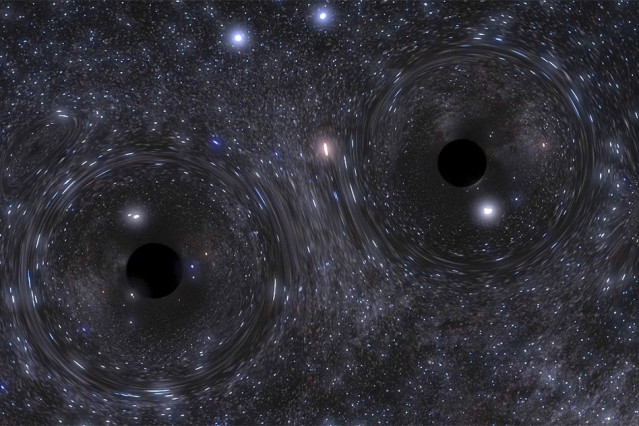
A snapshot of a simulation showing a binary black hole (Image courtesy Northwestern Visualization/Carl Rodriguez. All rights reserved)

An article published in the journal “Physical Review Letters” describes the simulations of the evolution of globular clusters of the type commonly found in galaxies to assess the possibility of black holes mergers. A team led by MIT astrophysicist Carl Rodriguez used the Quest supercomputer at Northwestern University to simulate 24 clusters with different characteristics, also calculating relativistic effects, concluding that repeated mergers can occur, forming black holes more massive than the stellar ones.

The Horsehead Nebula

Two articles, one published in the journal “The Astronomical Journal” and one in the journal “Astronomy and Astrophysics”, describe as many researches on the Horsehead Nebula, iconic for its particular shape. Two teams of researchers used NASA’s SOFIA flying observatory to map the distribution of gas and dust connected to the star formation activity within it.