2018

Part of Perseverance Valley (Image NASA/JPL-Caltech)

NASA has published new photos taken by its venerable Mars Rover Opportunity, which after 14 Earth years and 5,000 Sols – Martian days – continues its scientific mission on the planet Mars. In the ancient valley called Perseverance Valley it found a soil with a texture that resembles certain very particular rock strips on some mountain slopes on the Earth. These formations can be created by cycles of freezing and thawing of moist soil or wind, downhill transport or other processes.

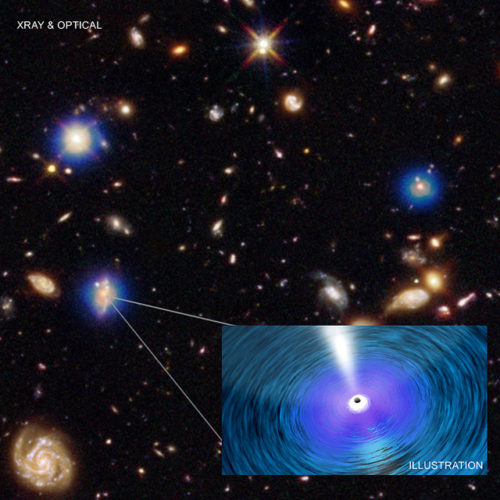
Supermassive black holes in the Chandra Deep Field-South (Image NASA/CXC/Penn. State/G. Yang et al and NASA/CXC/ICE/M. Mezcua et al.; Optical: NASA/STScI; Illustration: NASA/CXC/A. Jubett)

Two articles currently being published in the journal “Monthly Notices of the Royal Astronomical Society” describe two researches on the connection between the development of supermassive black holes and the galaxies that host them. Two separate teams used observations from NASA’s Chandra X-ray Observatory and other telescopes, concluding that supermassive black holes grow faster than new stars form in their host galaxies. This contradicts previous models that suggested a growth proportional to star formation in the galaxies.

M77's active galactic nucleus with the gas moving in the inset (Image ALMA (ESO/NAOJ/NRAO), Imanishi et al.)

An article published in the journal “Astrophysical Journal Letter” describes the best observation ever made of a ring of gas and dust surrounding a supermassive black hole. A team of astronomers used the ALMA radio telescope to observe the active galactic nucleus (AGN) of the M77 spiral galaxy that emits the intense electromagnetic radiation detected. This is the definitive proof of what was initially proposed as a theoretical concept for which increasingly clearer evidence was collected over time up to that presented in this research.

Hyperbolic trajectory of ʻOumuamua

An article published in the journal “Nature Astronomy” describes a research on the tumbling of the interstellar asteroid 1I/2017 U1, commonly known as ‘Oumuamua. According to a team of astronomers led by Queen’s University Belfast, that motion is due to an impact with another object that occurred before it was ejected from its solar system and could continue for at least another billion years.