2018

The Cartwheel Galaxy (Image ESA/Hubble & NASA)

An image captured by the Hubble Space Telescope shows the Cartwheel Galaxy shows its particular structure that combines features of a lenticular galaxy and a ring galaxy. Its unusual shape is probably the result of a collision with another smaller galaxy that caused a series of shock waves in its nucleus that pushed gas and dust outwards. A long-term consequence of that accumulation of gas in the outer ring is the birth of a lot of massive stars, visible in blue.

The possible look of TRAPPIST-1's planets (Image NASA/R. Hurt/T. Pyle)

An article published in the journal “Astronomy & Astrophysics” describes a study of the internal structure and tidal warming of the 7 planets of the ultra-cool dwarf star TRAPPIST-1 system. Amy C. Barr, Vera Dobos, and László L. Kiss created models of those 7 planets, concluding that two of them are most likely to be habitable because the temperatures on their surface could allow the presence of liquid water.

Artist's concept of winds around a black hole stealing gas from a companion (Image courtesy NASA/Swift/A. Simonnet, Sonoma State University)

An article published in the journal “Nature” describes the study of 12 binary systems with X-ray emissions and the presence of a black hole. A team of researchers found evidence of the continuous presence of strong winds that surround the black holes studied throughout their outbursts, which consist in very intense emissions. This research offers new information on the way in which masses move towards black holes and on black holes’ influence on the environment around them.

Rendering of the possible surface of K2-141b (Image courtesy Marco Galliani/INAF)

Two articles, one to be published in “The Astronomical Journal” and one to be published in the journal “Astronomy and Astrophysics”, describe the study of the exoplanet K2-141b, a super-Earth very close to its star, so much that its year lasts only 6.7 hours. A team of researchers led by Luca Malavolta of the University of Padua and the Italian National Institute of Astrophysics used the National Galileo Telescope and its HARPS-N spectrograph to study it.

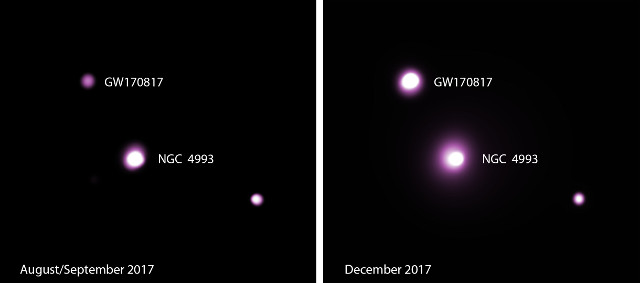
X-ray emissions from the GW170817 source (Image NASA/CXC/McGill/J.Ruan et al)

An article published in the journal “Astrophysical Journal Letters” describes the analysis of the observations of the afterglow from the merger of two neutron stars detected last August and announced in October. A team of researchers used NASA’s Chandra X-ray observatory to study the consequences of that event noting that the glow continued, indicating that the gamma-ray burst generated from that collision is more complex than the scientists initially thought.