2018

An article published in the journal “The Astrophysical Journal” describes a new research on the possible climate existing on the seven rocky planets of the star TRAPPIST-1’s system. A team of astronomers coordinated by the University of Washington (UW) used updated climate models to try to understand what kind of atmospheres they can have as a result of environmental evolution based on the observations collected. The result is that the planet TRAPPIST-1 e is the one most likely to have liquid water on its surface.

The star HD 186302 at the center (Image courtesy CDS Portal/Simbad)

An article published in the journal “Astronomy & Astrophysics” describes the discovery of a twin star of the Sun. It’s HD 186302, studied by a team of researchers led by Vardan Adibekyan of the Instituto de Astrofísica and Ciências do Espaço (IA), in Portugal, starting from the data collected by the AMBRE project that collected about 230,000 star spectra, along with other data collected by ESA’s Gaia space probe. HD 186302 is really similar to the Sun not only as an age and chemical composition but also in mass and size and this offers hopes that it has planets similar to the Earth.

The brightest known galaxy is devouring its neighbors

An article published in the journal “Science” describes a study of the galaxy W2246-0526, the brightest known. A team of researchers used the ALMA radio telescope to examine it by uncovering streams of materials as they are stripped from three smaller galaxies orbiting it. In one case a “tidal tail” is generated, a large stram of materials that connects W2246-0526 with one of its satellites. According to an article published in “The Astrophysical Journal” the supermassive black hole at its center has a mass that’s about 4 billion times the Sun’s.

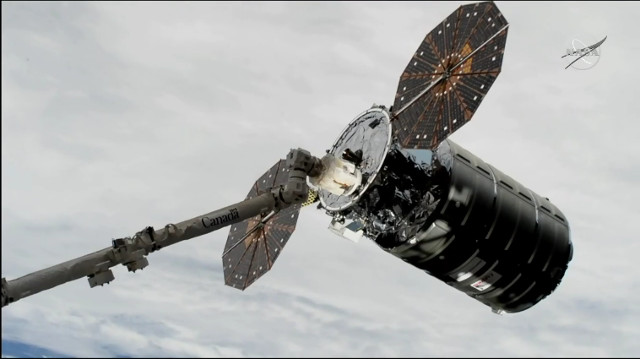
The Cygnus John Young cargo spacecraft captured by Canadarm2 robotic arm (Image NASA TV)

The Northrop Grumman Cygnus spacecraft, launched last Saturday, November 17, has just reached the International Space Station and was captured by Canadarm2 robotic arm. Astronaut Serena Auñón-Chancellor, assisted by her colleague Alexander Gerst, will soon begin the slow maneuver to move the Cygnus until it docks with the Station’s Unity node after about two hours.