2018

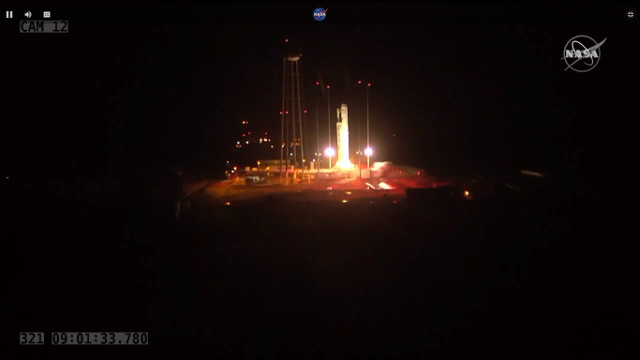
The Cygnus John Young cargo spacecraft blasting off atop an Antares rocket (Image NASA TV)

A little while ago Northrop Grumman’s Cygnus spacecraft blasted off atop an Antares rocket from the Mid-Atlantic Regional Spaceport (MARS), part of NASA’s Wallops Flight Facility (WFF) on Wallops Island. After about nine minutes it successfully separated from the rocket’s last stage went en route to its destination. This is its tenth official mission, called NG-10 but also CRS NG-10, to transport supplies to the International Space Station for NASA.

Artist's concept of Barnard's Star and its planet Barnard’s Star b (Image ESO/M. Kornmesser)

An article (link to PDF file) published in the journal “Nature” describes the discovery of a possible super-Earth orbiting the Barnard’s Star, a red dwarf that in astronomical terms is in the neighborhood being about 6 light years away from the Earth. The Red Dots and CARMENES projects led to the discovery of what was named Barnard’s Star b and could be the second exoplanet closest to the solar system after Proxima b.

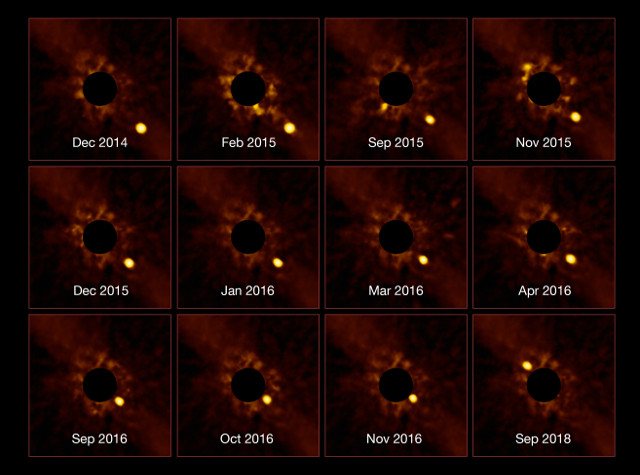
Beta Pictoris b (Image ESO/Lagrange/SPHERE consortium)

ESO has published a time-laps composition of images showing the exoplanet Beta Pictoris b while orbiting its star. It was discovered in 2008 using the NACO instrument mounted on the VLT in Chile and the team led by Dr. Anne-Marie Lagrange who discovered it kept on studying it some years later using the SPHERE instrument, which in the meantime was also mounted on the VLT. The researchers lost sight of it when it approached its star’s halo too closely to be resolved by any current instrument but got visible again in September 2018.

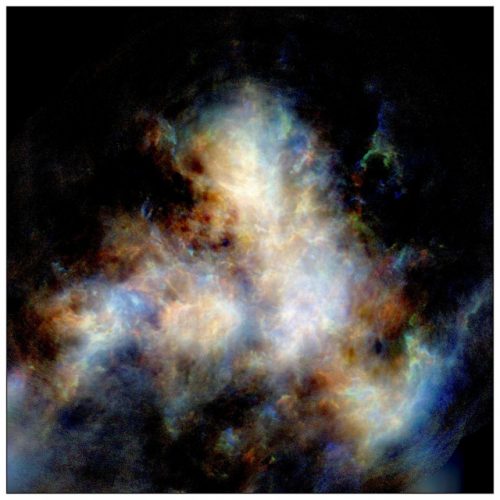
Hydrogen in the Small Magellanic Cloud (Image courtesy Naomi McClure-Griffiths et al, CSIRO's ASKAP telescope. All rights reserved)

An article published in the journal “Nature Astronomy” describes the study of a gas outflow from the Small Magellanic Cloud that extends for at least 6,500 light years from its star formation area. A team of researchers used the ASKAP radio telescope to observe that dwarf galaxy in its entirety in a single shot with details never seen before. The conclusion is that there’s a gas loss resulting in a drop in star formation. That gas could be a source for what is known as Magellanic Stream and over time the Small Magellanic Cloud could be devoured by the Milky Way.