
An article published in “The Astrophysical Journal” reports the discovery of four massive molecular clouds in the central area of the Milky Way with traces of star formation in an area that was considered too chaotic for that to happen. A team of researchers used the ALMA radio telescope to examine the so-called Milky Way’s Central Molecular Zone (CMZ), discovering over 800 of what are considered stellar eggs, meaning dense cores of gas and dust. ALMA made it possible to detect 43 energetic outflows of materials with characteristics associated with star formation, further evidence of what’s happening in that area.
According to star formation models, inside molecular clouds, certain conditions are needed for stars to be born. In the Milky Way’s Central Molecular Zone, within a radius of about 1,000 light-years from the galactic center, those conditions are not supposed to exist. On the contrary,, tidal forces, powerful magnetic fields, energetic particles, and frequent supernovae should have inhibited star formation in that area. The only star-formation region in that area known so far was Sagittarius B2 (Sgr B2). Consequently, the astronomers who found traces of star formation in other molecular clouds in that area were surprised.
The researchers harnessed the power and sensitivity of the ALMA (Atacama Large Millimeter/submillimeter Array) radio telescope, inaugurated in March 2013, to investigate where other studies concluded that the environment was too harsh for star formation. Their research was fruitful with the discovery of over 800 gas and dust dense cores. These are cores that over time attract more materials until they reach the critical mass that triggers nuclear fusion. For this reason, they’re considered star eggs.
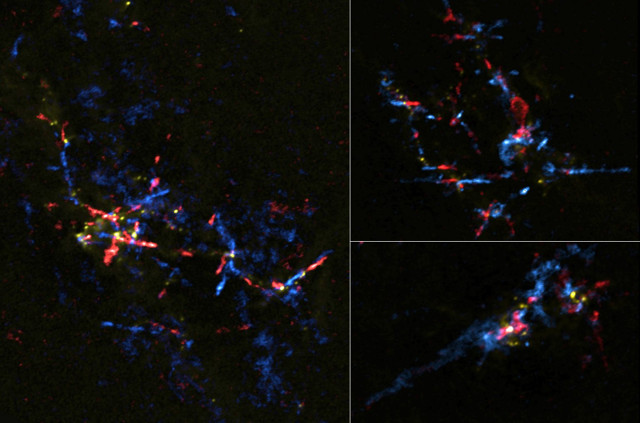
Such a discovery required confirmation, so the researchers continued to observe those molecular clouds with the ALMA radio telescope, discovering 43 outflows of energetic materials inside them. The characteristics of those outflows are closely associated with star formation, so that’s considered evidence that new stars are actually being born in an area where this seemed very unlikely. The image (ALMA (ESO/NAOJ/NRAO), Lu et al.) shows a composition of some outflows indicating an origin from protostars.
A mystery is the discovery of just 43 outflows associated with star formation with over 800 objects that look like stellar eggs. This could mean that those protostellar cores are in a very early stage of their formation, so the outflows will begin later. Other outflows may be invisible even to ALMA.
What emerges from this study is a star-forming activity similar to that observed relatively close to the solar system, away from the Milky Way’s center and the chaos of that area. The researchers intend to continue studying the data collected to better understand the processes taking place in the Milky Way’s Central Molecular Zone. Understanding the differences from star formation processes in other less chaotic areas will help better understand the conditions under which they can occur.
