A series of articles published in the “Astrophysical Journal Supplement Series” reports the detection of organic molecules potentially important for the birth of life forms in some protoplanetary disks. A team of researchers used the ALMA radio telescope as part of the MAPS program. ALMA made it possible to detect the emissions of molecules such as cyanoacetylene, acetonitrile, and cyclopropenylidene in the disks of young stars IM Lupi, GM Aurigae, AS 209, HD 163296, and MWC 480. These organic compounds are precursors of more complex molecules important in biological processes and some of them are similar to those that formed in the solar system.
Instruments of great power and sensitivity such as the ALMA (Atacama Large Millimeter/submillimeter Array) radio telescope, inaugurated in March 2013, are making it possible to examine the various processes taking place in star systems in their formation phase around young stars. Organic molecules of various types have been discovered in various cases and simple compounds such as hydrogen cyanide, formaldehyde, and many others have been found to be common. The MAPS (Molecules with ALMA at Planet-forming Scales) program aims to map those molecules in five protoplanetary disks 300 to 500 light-years away from Earth to understand which ones are present in the different systems and their distribution.
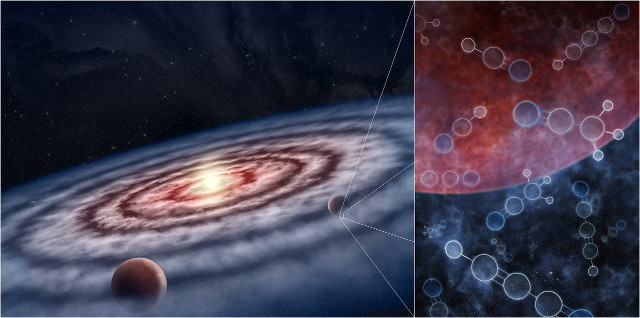
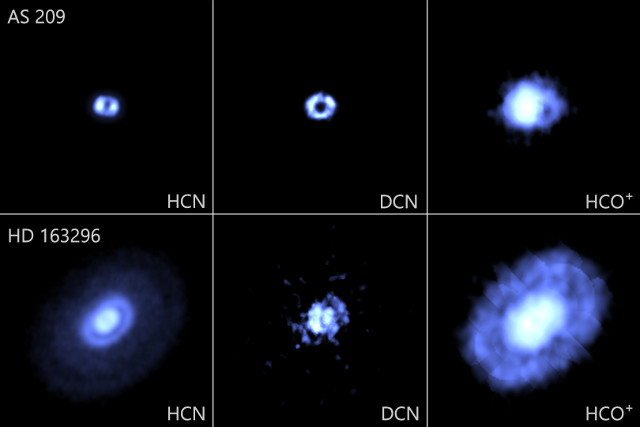
The results are diverse in the sense that different molecules with different distributions have been found in different protoplanetary disks. The top image (ALMA (ESO/NAOJ/NRAO), Cataldi et al./Aikawa et al.) shows an example of this distribution with some molecules mapped in the protoplanetary disks around the stars AS 209 and HD 163296. The bottom image (M.Weiss/Center for Astrophysics | Harvard & Smithsonian) shows an artistic illustration of a planet forming in a protoplanetary disk with molecules inside it detected by the MAPS program.
Within each of the protoplanetary disks examined, the various chemical compounds are unevenly distributed. This means that each of the planets that are forming or will form in the future will be “seeded” with different compounds. This is another factor to keep in mind when assessing a planet’s habitability potential.
The discovery of organic molecules of a certain complexity such as cyanoacetylene, acetonitrile, and cyclopropenylidene is interesting because they are precursors of more complex molecules. They’re important in the formation of compounds crucial for Earth’s life forms such as amino acids, sugars, and even components of RNA.
The MAPS program offered results that were unthinkable in the past decades but the research is far from over. The chemical complexity present in the protoplanetary disks came as a surprise to the researchers and is a stimulus for follow-up studies. Other protoplanetary disks are known besides the ones examined, so this type of study can be expanded. This will help to better understand the chemical processes that take place during the formation of a planetary system and what conditions can create a potential for the formation of life.