
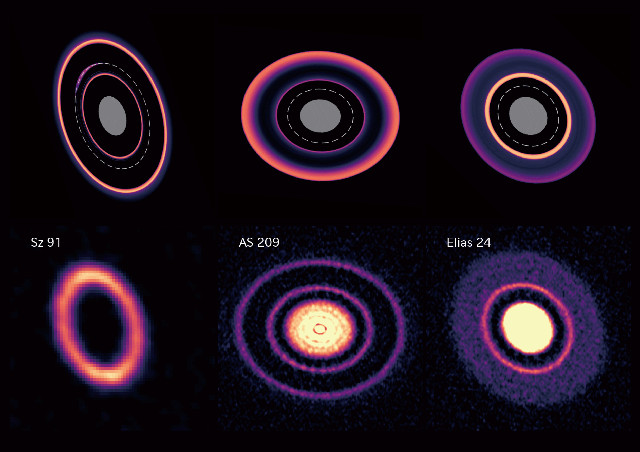
An article published in “The Astrophysical Journal” reports a study on protoplanetary disks that offers a solution to the rarity of the discovery of newborn exoplanets near the rings that form inside them. A team of three Japanese researchers used the ATERUI II supercomputer, the most powerful used in astronomy, to create simulations of planetary systems’ evolution. The results indicate that the planets create rings as they grow but subsequently move away from them.
Over the years, astronomers have discovered a series of newborn stars and protostars surrounded by protoplanetary disks in various stages of evolution. The ALMA (Atacama Large Millimeter/submillimeter Array) radio telescope made it possible to study many of these disks, and this led to significant advances in modeling planetary formation. A phase that now is taken for granted is the formation of gaps in the disk, which is transformed into a series of concentric rings, following the formation of planets. However, observations indicate that it’s rare to find newborn exoplanets near the rings, an oddity for which an explanation has been offered in this new study.
Kazuhiro Kanagawa, Takayuki Muto, and Hidekazu Tanaka conducted a series of simulations of the evolution of planets within a low-viscosity protoplanetary disk. The results indicate that a planet can move away from the area in which it formed but the ring that formed doesn’t move with it.
The three researchers identified three phases in a protoplanetary disk following the birth of a new planet. In the first phase, the initial ring remains intact as the planet moves inward within its system. In the second phase, the initial ring starts deforming and a second ring starts forming in the new planet location. In the third phase, the initial ring disappears and only the second ring remains.
The simulation results were compared with real protoplanetary disks observed with the ALMA radio telescope. The image (Courtesy Kazuhiro D. Kanagawa, ALMA(ESO/NAOJ/NRAO). All rights reserved) shows a comparison between the three phases of the evolution of rings in a protoplanetary disk simulated by the supercomputer ATERUI II, at the top line, and three protoplanetary disks observed with the ALMA radio telescope, at the bottom line. The dotted lines in the simulated disks indicate the orbits of the planets while the gray areas indicate regions not included in the area processed by the simulations.
The simulations have a good match with real protoplanetary disks offering a plausible explanation of why it’s rare to find planets near the outer rings of those disks. These results will allow conducting follow-up observations to search for planets in the areas predicted by this model. The instruments that will enter service in the coming years will offer more possibilities for this type of research to unlock the secrets of planetary formation.
