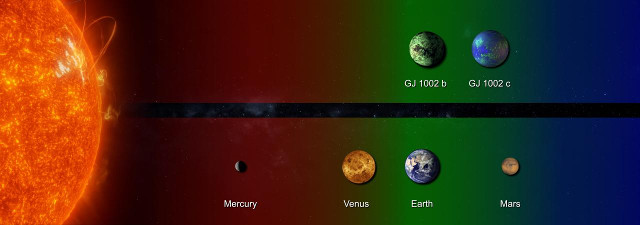
An article published in the journal “Astronomy & Astrophysics” reports the discovery of two exoplanets that are slightly larger than Earth in the GJ 1002 star system, almost 16 light-years away from Earth. A team of researchers used a combination of data collected by two spectrographs, ESPRESSO mounted on the VLT and CARMENES at the Calar Alto observatory, to study GJ 1002 and find the traces of two exoplanets around it. Both of them are within their system’s habitable zone where there could be conditions similar to those on Earth. The top image (Courtesy Alejandro Suárez Mascareño and Inés Bonet (IAC)) shows an artist’s impression of the GJ 1002 system with its two planets.
GJ 1002, or Gliese 1002, is a red dwarf with a mass that is only 12% of the Sun’s. For this reason, its system’s habitable zone is much closer to it than Mercury is from the Sun. From an astronomical point of view, it’s in the Earth’s neighborhood, and for this reason, it’s become an object of research also regarding possible exoplanets.
The CARMENES (Calar Alto high-Resolution search for M dwarfs with Exoearths with Nearinfrared and optical Echelle Spectrographs) instrument was designed precisely to search for Earth-type planets around red dwarfs and was used to obtain 86 observations of GJ 1002 between 2017 and 2019. The ESPRESSO (Echelle SPectrograph for Rocky Exoplanets and Stable Spectroscopic Observations) instrument mounted on the VLT (Very Large Telescope) has a similar purpose and was used to obtain 53 observations of GJ 1002 between 2019 and 2021.
The teams managing the CARMENES and ESPRESSO instruments joined forces to have enough data to understand if there were planets around GJ 1002. This task would have been very difficult for each of the two teams working autonomously because the signals collected from each of the two instruments were not clear. Their collaboration made it possible to obtain excellent results precisely from the combination of data collected finding two exoplanets. The data analysis provided really interesting results.
The two exoplanets discovered around GJ 1002 are slightly more massive than Earth and are both in their star system’s habitability zone. For now, there’s no guarantee that they have an atmosphere but if they had one similar to the Earth’s, they could be habitable. One problem with red dwarfs is that they’re small but are often very active with powerful flares that are detrimental to their planets. GJ 1002 is part of the minority of red dwarfs with little activity and this greatly increases the chances that its planets have an atmosphere.
The exoplanet GJ 1002 b has a mass just greater than the Earth’s with a year lasting just over 10 Earth days. It receives from its star about two-thirds of the stellar radiation that the Earth receives from the Sun. These conditions make it promising in terms of habitability potential.
The exoplanet GJ 1002 c has a mass that is about a third higher than the Earth’s with a year lasting just over 21 Earth days. It receives from its star about a quarter of the stellar radiation that the Earth receives from the Sun. From this point of view, it’s similar to Mars, which doesn’t make it very promising concerning its habitability potential. However, the presence of an atmosphere could make a huge difference if a greenhouse effect were enough to keep liquid water on at least part of the surface.
The bottom image (Courtesy Alejandro Suárez Mascareño (IAC). Solar System Planets: NASA) shows an infographic comparing GJ 1002’s system to the inner solar system with the green band indicating the habitable zone. The two planets of GJ 1002 are very close to their star, making them excellent candidates for studies of their possible atmospheres based on their reflected light or thermal emissions.
It will be necessary to conduct in-depth studies of these two exoplanets, also with instruments that will enter service in the coming years, to understand their actual habitability potential. Thanks to their proximity to the Earth, they are excellent objects of study from a scientific point of view regardless of their habitability.