
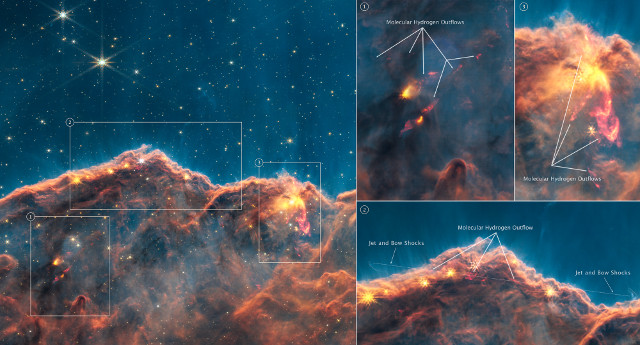
The activity of protostars and newborn stars in the Cosmic Cliffs studied by the James Webb Space Telescope
An article published in the journal “Monthly Notices of the Royal Astronomical Society” reports a study of the open cluster NGC 3324, part of the Carina Nebula, one of the largest known star nurseries. A team of researchers used observations conducted with the James Webb Space Telescope to specifically study an area on the edge of NGC 3324 nicknamed the Cosmic Cliffs. The nickname is due to the jagged appearance like a cliff but instead of water and rocks, there’s an expanse of gas and dust. The amplitude of the infrared frequencies detected by Webb made it possible to obtain more details than ever of what is happening in the midst of those cosmic clouds, finding 24 new outflows of molecular hydrogen associated with as many protostars.
