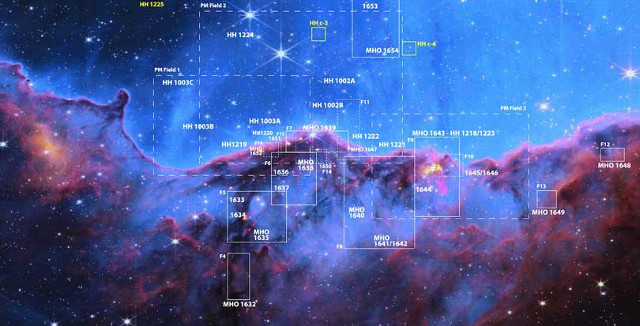
An article published in the journal “Monthly Notices of the Royal Astronomical Society” reports a study of the open cluster NGC 3324, part of the Carina Nebula, one of the largest known star nurseries. A team of researchers used observations conducted with the James Webb Space Telescope to specifically study an area on the edge of NGC 3324 nicknamed the Cosmic Cliffs. The nickname is due to the jagged appearance like a cliff but instead of water and rocks, there’s an expanse of gas and dust. The amplitude of the infrared frequencies detected by Webb made it possible to obtain more details than ever of what is happening in the midst of those cosmic clouds, finding 24 new outflows of molecular hydrogen associated with as many protostars.
The Cosmic Cliffs on the edge of the NGC 3324 cluster were already studied several times in the past to try to find traces of protostars and newborn stars or stars that are still very young in astronomical terms. In these cases, the problem is that the clouds of gas and dust in which they formed block many electromagnetic frequencies. Infrareds are among the few that pass through those clouds and one reason why the James Webb Space Telescope was designed to see more widely in infrared than other instruments like Hubble.
Star formation makes Cosmic Cliffs of particular interest to astronomers and this is why they were chosen as a target for the first images captured with the James Webb Space Telescope to be published. Compared to Hubble, Webb has greater sensitivity which allowed to examine more distant regions, and a more extensive infrared sight which allowed to look deeper inside the clouds at the first stages of star formation.
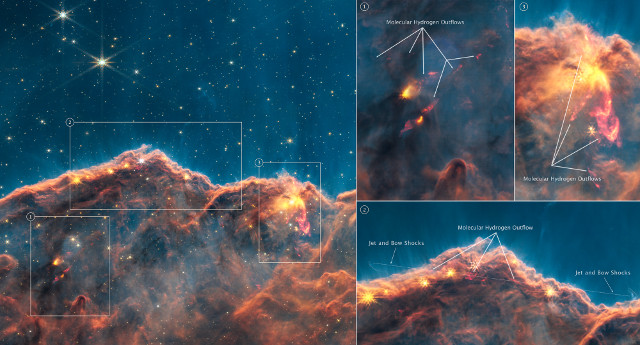
The top image (NASA, ESA, CSA, STScI. Science: Megan Reiter (Rice University). Image processing: Joseph DePasquale (STScI), Anton M. Koekemoer (STScI)) shows the Cosmic Cliffs and in the insets on the right side the details of some areas with indications of hydrogen outflows, jets, and bow shocks, the shock waves caused by that activity.
Megan Reiter of Rice University, the lead author of this study, explained that Webb gives us a snapshot that allows us to see how much star formation is taking place in what could be a typical corner of the universe that we could not see before. She also stated that we now know where to look next to explore which variables are important for the formation of Sun-like stars.
In particular, the James Webb space telescope made it possible to trace the movements of molecular hydrogen, the gas that forms new stars. Some of that hydrogen is ejected in jets emitted at the stellar poles in the first millennia of a star’s life. For this reason, those outflows are compared to birth cries coming from those stars.
Already known hydrogen outflows and 24 new ones were observed by the James Webb Space Telescope in the Cosmic Cliffs at the edge of the NGC 3324 cluster. The bottom image (NASA, ESA, CSA and STScI) shows an area of the Cosmic Cliffs seen by the James Webb Space Telescope’s Near-Infrared Camera (NIRCam) instrument with the indications of the jets associated with the forming stars.
Regarding the already known outflows, the researchers were able to estimate the speed and direction of the gas jets by comparing the observations conducted with Webb with those in the Hubble archive dating back 16 years ago. In this phase, the activity of protostars and newborn stars is very quick in astronomical terms, so 16 years already make a certain difference.
Stellar nurseries such as the Carina Nebula and its various regions were included among the first targets of the James Webb Space Telescope because astronomers believed they would obtain very interesting new data on star formation. This study proves them right and only covers an area of space that is small in astronomical terms. This means that we can look forward to new extraordinary images of other star-forming regions and above all, new data on the processes that lead to the formation and evolution of new stars and new planets.