
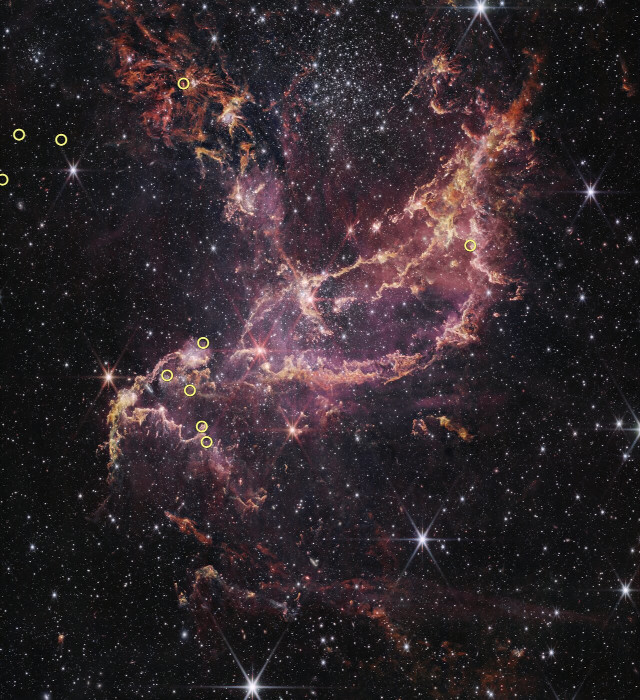
An article published in “The Astrophysical Journal” reports the results of the study of a group of protoplanetary disks with an age of up to 30 million years, even 10 times older than current models of planet formation predict. A team led by Guido De Marchi of ESA’s European Space Research and Technology Centre used observations conducted with the James Webb space telescope of the cluster NGC 346, in the Small Magellanic Cloud. That region is characterized by a limited amount of elements heavier than hydrogen and helium, just like the early universe. This study confirms that in those conditions, protoplanetary disks can last much longer than astronomers thought.
In the early Universe, there was almost only hydrogen and oxygen, and astronomers doubted that planets could form in those conditions. Astronomers thought that protoplanetary disks could last for 2 or 3 million years without a significant component of heavy elements. It seemed too little for planetary formation but there were doubts about this model in the past already.
In 2003, the Hubble Space Telescope allowed to discover an exoplanet in the globular cluster M4 that is much more massive than Jupiter and orbits a very ancient star. It has an estimated age of around 13 billion years, which means that the star and the planet formed from a cloud that contained almost only hydrogen and helium.
To test the hypotheses regarding protoplanetary disks, quality observations are needed, including spectroscopic ones, to confirm that they are indeed protoplanetary disks. The Hubble Space Telescope had already revealed in the cluster NGC 346 a large population of candidate pre-main sequence objects, in simple words, possible protostars with possible protoplanetary disks. However, even Hubble couldn’t offer certainty that this was indeed their nature and that they weren’t other objects that appeared to be superimposed or at least very close.
The James Webb Space Telescope provided the information hoped for, offering the quality needed to ascertain the nature of the candidates studied. This confirmed that in this cluster in the Small Magellanic Cloud, there are protostars and newborn stars surrounded by protoplanetary disks with an age between 100,000 and 30 million years.
These confirmations lead to the need to modify the models of planetary formation to explain those protoplanetary disks’ long life. The authors of this study proposed two possible mechanisms, which are not mutually exclusive but could both be active and combine their effects.
The first proposed mechanism predicts that a star that is very poor in heavy elements takes longer than it was predicted to sweep away the materials surrounding it with a stellar wind formed almost exclusively by hydrogen and helium.
The second proposed mechanism predicts that to form a star similar to the Sun with very few heavy elements, a larger cloud of gas is needed. The consequence would be the formation of a larger and therefore more massive protoplanetary disk that could resist the effects of stellar winds for a longer time.
A longer life of protoplanetary disks would also lead to longer accretion times of protoplanets, which could become more massive. In short, the discovery of these long-lived disks has implications for what kind of planets can emerge in different environments depending on their chemical composition. In essence, this study could pave the way for substantial improvements in planetary formation models that will have to take into account a new way of thinking about these processes.
