2024

The protostar forming within the L1527 molecular cloud observed by the James Webb Space Telescope's MIRI instrument

A new image captured by the James Webb Space Telescope reveals new details of a protostar forming within the molecular cloud cataloged as L1527. The MIRI instrument offered new information on the ongoing processes that are leading to the birth of a new star. An accretion disk is barely visible edge-on and is important because the protostar is still absorbing materials from it and planets could form within it in the future. During its formation, the protostar emits jets of gas that collide with the remains of the surrounding cloud, generating the structures MIRI sees in a color that is blue in the top image (NASA, ESA, CSA, STScI) thanks to the presence of polycyclic aromatic hydrocarbons (PAHs), compounds that are common in space.

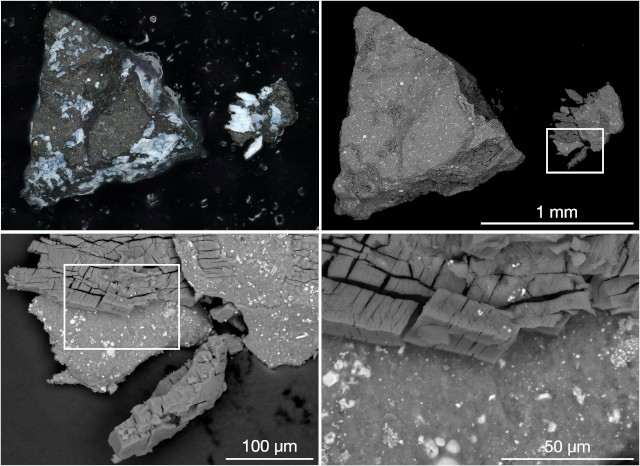
At the top left a sample taken from the asteroid Bennu and in the subsequent panels increasingly zoomed views of a fragment that broke off along a bright vein that contains phosphate, captured under an electron microscope

An article published in the journal “Meteoritics & Planetary Science” reports the results of the preliminary analysis of the samples of material from asteroid Bennu brought back to Earth by NASA’s OSIRIS-REx space probe. A team of researchers conducted morphological and chemical analyzes of the samples, finding a lot of carbon and nitrogen together with organic compounds, all very important components for life forms of the Earth’s type.

The surprise came from the discovery of magnesium-sodium phosphate, which wasn’t detected by the instruments aboard OSIRIS-REx. This compound forms in water-rich environments and suggests that Bennu may be a fragment of a primordial world that had an ocean. The researchers mentioned Enceladus, Saturn’s moon with a subterranean ocean where sodium phosphate was found, and suggest a possible link to Bennu.

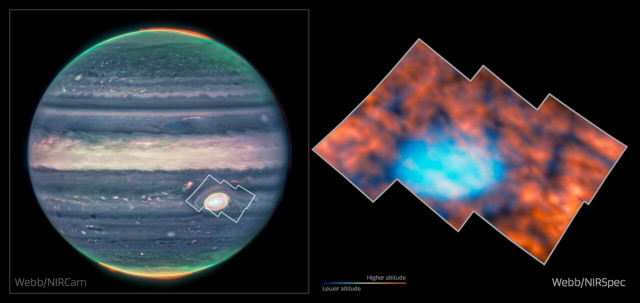
On the left the planet Jupiter seen by the James Webb Space Telescope's Near-Infrared Camera (NIRCam) instrument and on the right the Great Red Spot observed by the Near-InfraRed Spectrograph (NIRSpec) instrument

An article published in the journal “Nature Astronomy” reports the identification of structures in the planet Jupiter’s upper atmosphere above the Great Red Spot, the iconic storm larger than the Earth. A team of researchers led by Henrik Melin of the British University of Leicester used observations conducted with the James Webb Space Telescope to obtain new details of that area. The surprise came from the identification of intricate structures including dark arcs and bright spots in the observed area.

The capsule with the samples from the Chang-e 6 mission after landing (Image courtesy CCTV)

A little while ago, the capsule carrying the Moon samples taken during the Chang’e-6 mission landed in the Siziwang Banner, meaning an autonomous county of Inner Mongolia. The lander with the return module landed on the Moon when in China it was June 2, spent about two days collecting samples, and the return module took off to transport the samples to orbit and start the voyage back to Earth. Recovery personnel found the capsule, which will be transported to a laboratory in Beijing, where operations will begin to open it without contaminating its contents.

The Serpens Nebula observed by the James Webb Space Telescope

An article accepted for publication in “The Astrophysical Journal” reports the first detection of aligned bipolar jets emitted by protostars in the Serpens Nebula. A team of researchers used observations conducted with the James Webb Space Telescope to obtain the details needed to spot these jets. Typically, they have different orientations within a star-forming region but in this case, they are aligned almost perfectly. This suggests that star formation may be at a unique time in its history in the Serpens Nebula and provide crucial information about these processes.