2024

The pair of quasars photographed by the Hyper Suprime-Cam mounted on Subaru Telescope

An article published in the journal “The Astrophysical Journal Letters” reports the discovery of the most distant pair of merging quasars known. A team of researchers combined observations from the Subaru Telescope with the Gemini North Telescope to find traces of this pair of quasars that we see as they were about 900 million years after the Big Bang.
Studying this pair of quasars can offer new insights into the epoch of reionization, the period that began about 400 million years after the Big Bang and was crucial in the history of the universe. That’s the time when the neutral, light-blocking hydrogen was ionized, resulting in the universe becoming the bright place we know today. An article accepted for publication in a journal of the American Astronomical Society offers further analysis based on observations conducted with the ALMA radio telescope.

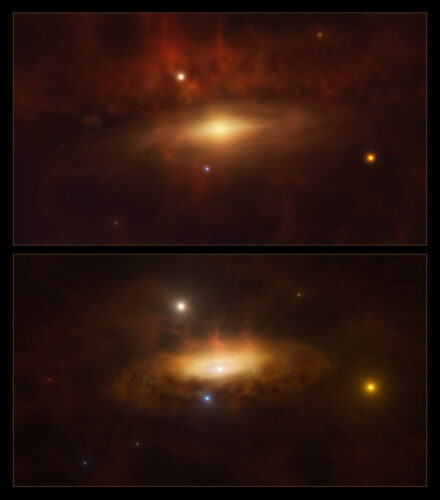
Artist's illustration of two phases of the formation of a disk of gas and dust around the supermassive black hole at the center of the galaxy SDSS1335+0728

An article accepted for publication in the journal “Astronomy & Astrophysics” reports the results of the observation of a new activity of the supermassive black hole at the center of the galaxy cataloged as SDSS J133519.91+072807.4 and called “simply” SDSS1335+0728. A team of researchers used observations conducted with various instruments to observe an increase in this galaxy’s brightness. This already led to its inclusion among those with an active galactic nucleus at the end of 2019.

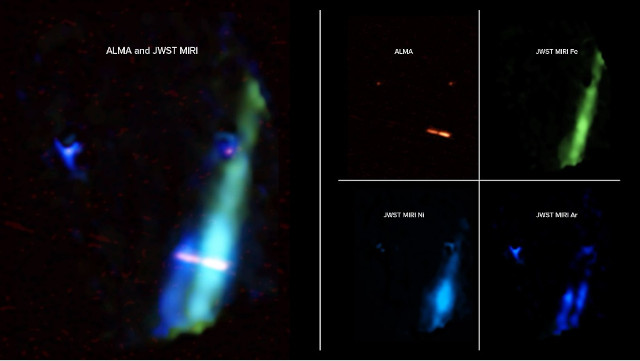
The WL20S system in a combination of ALMA and Webb observations

At the 244th Meeting of the American Astronomical Society, a study was presented of what turned out to be a pair of stars inside the WL20 group, cataloged as WL20S. The authors of this study combined observations conducted with the ALMA radio telescope and the James Webb Space Telescope to obtain the information necessary to establish that in that system there are two young stars, and not one as astronomers thought, which formed between 2 and 4 million years ago. Both stars are surrounded by disks of materials in which there could be planets forming and parallel jets of materials emitted by the two stars.

The Ceraunius Tholus volcano as seen by the TGO space probe's CaSSIS instrument with the frost in blueish

An article published in the journal “Nature Geoscience” reports the detection of frost on volcanoes in the Tharsis region on Mars. A team of researchers used data obtained from two ESA space probes, the ExoMars mission’s TGO and Mars Express, which made it possible to discover for the first time the presence of frozen water on the Martian surface at the red planet’s equator. In the calderas of the big volcanoes of Tharsis, blue deposits that can be attributed to water ice were spotted which are present only in the morning and then evaporate a few hours later.

Views of the Starliner Calypso spacecraft approaching the International Space Station in its Boe-CFT mission (Image NASA TV)

A few hours ago, Boeing’s CST-100 Starliner Calypso spacecraft docked with the International Space Station’s Harmony module, completing the first leg of its Boe-CFT (Boeing Crewed Flight Test) mission which began with the launch just over 24 hours earlier. After checking that the pressure was correctly balanced, the hatch was opened to allow Butch Wilmore and Suni Williams to enter the Station and begin their mission, which will last about a week.