2024

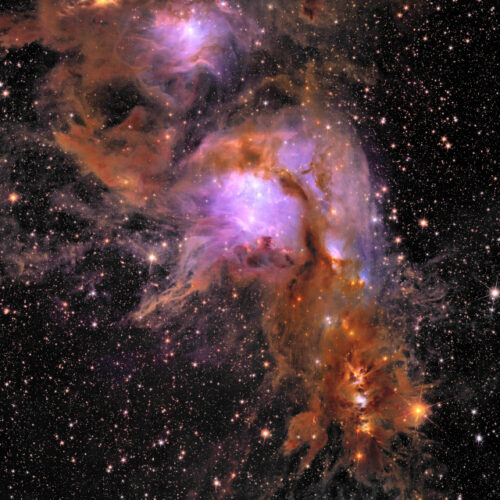
Messier 78 (ESA/Euclid/Euclid Consortium/NASA, image processing by J.-C. Cuillandre (CEA Paris-Saclay), G. Anselmi)

ESA and the Euclid Consortium have presented the first scientific results obtained thanks to the Euclid Space Telescope within the ERO (Early Release Observations) program. That’s a series of scientific articles partly written directly by the Consortium’s researchers and partly by different teams of researchers who worked within the ERO program. Some images illustrate the possibilities of this instrument but research into some of the major cosmological mysteries goes far beyond the aesthetics of photos.

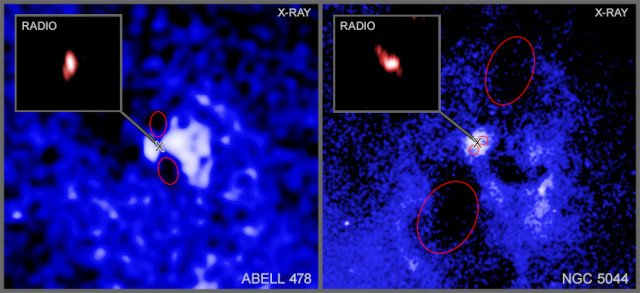
The galaxies Abell 478 and NGC 5044 seen in X-rays by the Chandra Observatory with data detected at radio waves by the VLBA (Very Large Baseline Array) radio telescope zoomed in the insets

An article published in “The Astrophysical Journal” reports a study of supermassive black holes that emit jets of energy that are aimed in different directions over time. A team of researchers led by Francesco Ubertosi of the University of Bologna, Italy, combined observations conducted with NASA’s Chandra X-ray Observatory and the VLBA radio telescope to examine 16 galaxies finding that about a third of their supermassive black holes emit jets that changed direction significantly within the last 10 million years. For this type of emission, they were compared to the Death Star.

A region near the center of the Milky Way

An article published in the journal “The Astrophysical Journal Letters” reports the results of observations of a structure similar to a chimney which functions as a sort of vent from which hot gas coming from Sagittarius A*, the supermassive black hole at the center of the Milky Way, escapes. A team of researchers combined observations conducted in X-rays with NASA’s Chandra Observatory and radio waves with the MeerKAT radio telescope to pinpoint that vent, which is located at about 700 light-years from the center of the Milky Way. This helps reconstruct the processes in which Sagittarius A* swallows materials and re-emits some of them.

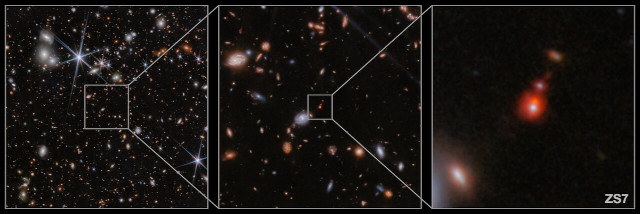
The position of the ZS7 system in past observations

An article published in the journal “Monthly Notices of the Royal Astronomical Society” reports evidence of the ongoing merger of two supermassive black holes in a pair of galaxies cataloged as ZS7 in the early universe. A team of researchers used observations conducted with the James Webb Space Telescope to obtain images of this event which we see as it was taking place when the universe was about 740 million years old and was therefore very young in astronomical terms. This is the most distant pair of merging black holes discovered so far and could offer insights valuable to understand how these extreme objects grew so quickly.

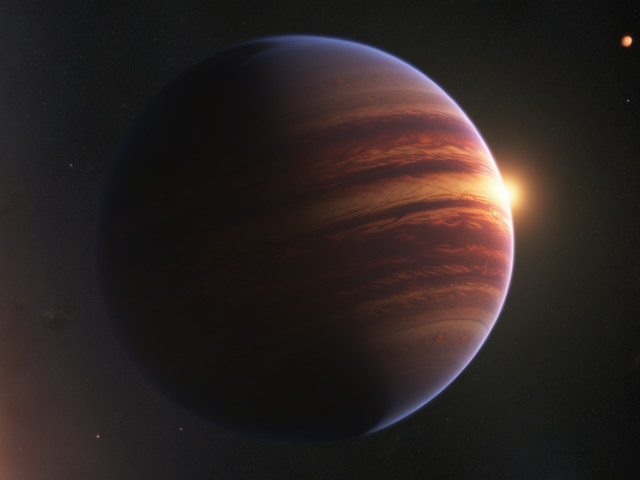
Artistic representation of the exoplanet WASP-193 b

An article published in the journal “Nature Astronomy” reports the identification of the exoplanet WASP-193 b, a gas giant whose diameter is approximately 1.5 times Jupiter’s but with a mass that is only one-seventh of Jupiter’s. A team of researchers led by Khalid Barkaoui of the University of Liège, Belgium, used the WASP-South telescope of the Wide Angle Search for Planets (WASP) collaboration to locate WASP-193 b and then study its characteristics with other instruments. The combination of this exoplanet’s mass and density is really difficult to explain since no theory of planetary formation leads to a planet like this.