2024

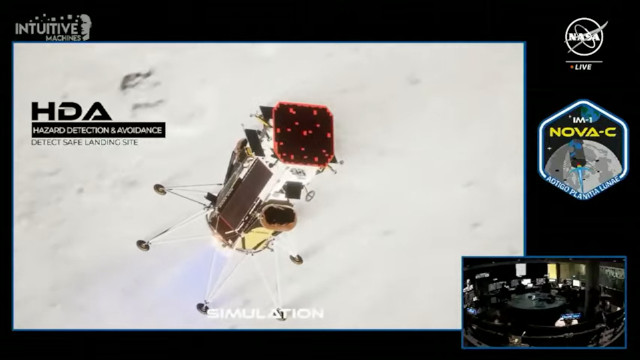
A simulation of Odysseus Moon landing (Image courtesy Intuitive Machines / NASA TV)

It was the afternoon in the USA when Intuitive Machines’ Nova-C Odysseus lander attempted its Moon landing in the Malapert A crater. It was an autonomous maneuver that constituted the crucial step of the IM-1 mission. It took about 10 minutes to receive the first faint signals from Odysseus but they were invaluable in confirming the Moon landing. At Intuitive Machines’ mission control center, work began to have regular communications that allow them to understand Odysseus’ exact status and receive the data collected, including images.

Artist's impression of a dust-generating Kuiper Belt collision (Image courtesy Dan Durda, FIAAA)

An article published in “The Astrophysical Journal Letters” reports a study of the presence of dust in the Kuiper Belt which suggests that it may be much more extended than previously thought or that there’s a second Belt outside the known one. A team of researchers used detections conducted with NASA’s New Horizons space probe’s Venetia Burney Student Dust Counter (VBSDC, or simply SDC) instrument to support these possibilities. That’s because current models indicate that dust density should decrease in the area where New Horizons is traveling, where detections are higher than expected.

The region of sky where quasar J0529-4351 is located. It was created from images forming part of the Digitized Sky Survey 2 while the inset shows the position of this quasar in the center in an image from the Dark Energy Survey.

An article published in the journal “Nature Astronomy” reports the identification of the brightest and most voracious quasar discovered so far, cataloged as J0529-4351. A team of researchers used various instruments to understand that it wasn’t a nearby star but a primordial quasar we see as it looked over 12 billion years ago.

The researchers estimated that the mass of the supermassive black hole that powers it is about 17 billion times the Sun’s, and it’s devouring materials around it at a very high rate, about the mass of the Sun every day. The study of this record-breaking primordial quasar can help reconstruct the history of the early universe and the processes that led to it becoming what it is today.

The Progress MS-26 cargo spacecraft blasting off atop a Soyuz-2.1a rocket (Image NASA TV)

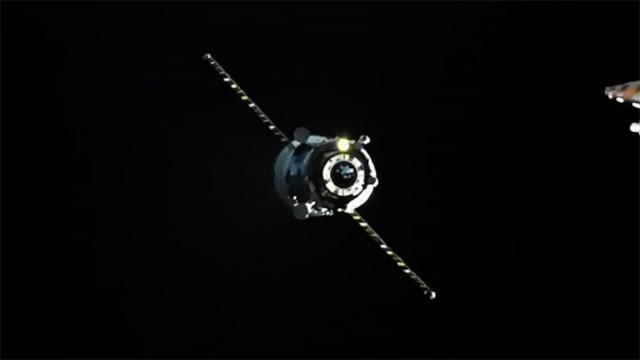
A few hours ago, the Progress MS-26 spacecraft blasted off atop a Soyuz-2.1a rocket from the Baikonur Cosmodrome in Kazakhstan. After about nine minutes it successfully separated from the rocket’s last stage and was placed on its route. The cargo spacecraft began its resupply mission to the International Space Station also called Progress 87 or 87P. In this mission, the route used is the one that requires about two days.