2024

A part of the IRAS 16562–3959 area (Image ESA/Hubble & NASA, R. Fedriani, J. Tan)

An image captured by the Hubble Space Telescope shows a part of the star-forming area cataloged as IRAS 16562–3959. The Wide Field Camera 3 (WFC3) instrument offers many details of that area at infrareds, in particular of the emissions coming from a massive star still in its formation phase whose consequences are visible in the part of the image that goes from the center towards the upper left and lower right. These and many other details can help reconstruct star formation processes.

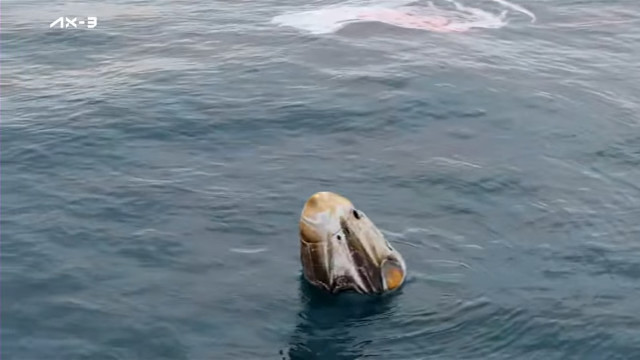
The Crew Dragon Freedom spacecraft after the splashdown that ended its Ax-3 mission (Image courtesy Axiom Space)

A little while ago, SpaceX’s Crew Dragon Freedom spacecraft concluded its Ax-3 mission by splashing down without problems. On board were Michael López-Alegría, Walter Villadei, Alper Gezeravcı, and Marcus Wandt, who ended this completely private space mission in the Atlantic Ocean after leaving the International Space Station almost 48 hours earlier. Shortly after splashing down, SpaceX’s recovery ship went to retrieve the Freedom and its crew to transport them to the coast.

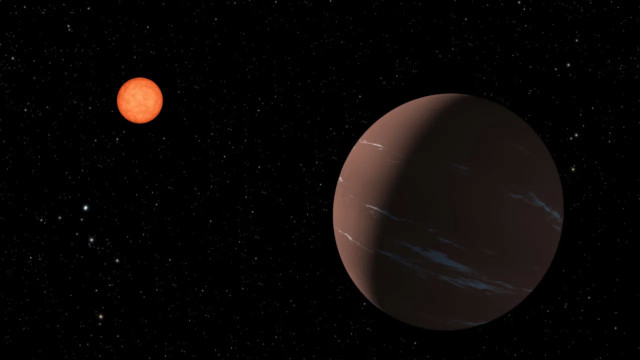
Artist's concept of the exoplanet TOI-715b with its star in the background (Image NASA / JPL-Caltech)

An article published in the journal “Monthly Notices of the Royal Astronomical Society” reports the identification of the exoplanet TOI-715 b in an orbit around its star in a position that meets the most conservative definition of a habitable zone. A team of researchers used observations conducted with NASA’s TESS space telescope confirmed by other instruments to identify what appears to be a super-Earth with a radius about 1.5 times the Earth’s. A second exoplanet candidate was discovered that would have a size very similar to the Earth’s a little further away from its star but follow-up observations are needed to verify that it’s not a false positive.

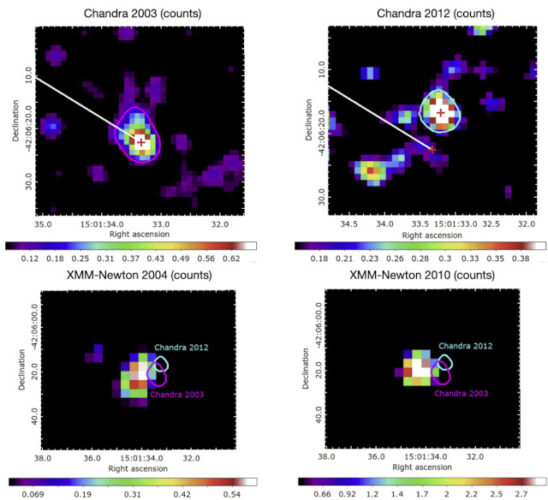
Four X-ray observations of the supernova remnants SN 1006

An article published in the journal “Astronomy & Astrophysics” reports a study of the supernova remnant cataloged as SN 1006 which led to the identification of an ejecta fragment of the progenitor star. A team of researchers led by Roberta Giuffrida of the University of Palermo and the Italian National Institute of Astrophysics used observations conducted with various telescopes exploiting X-ray emissions and compared them with theoretical models. The conclusion is that this iron-rich fragment is moving at a very high speed within the debris cloud generated by the supernova. This discovery is useful in the study of supernovae like this one, generated by explosions of white dwarfs.