2025

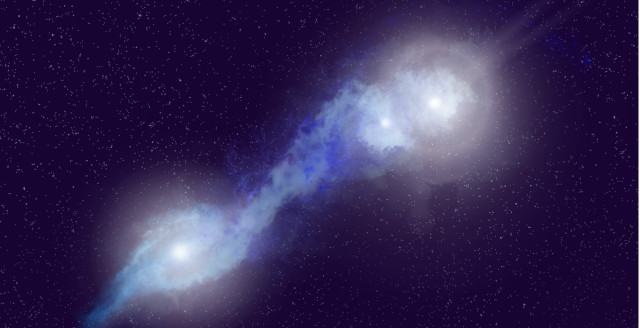
Artist's impression of the J1218/1219+1035 system (Image NSF/AUI/NSF NRAO/P. Vosteen)

A rare example of three active galactic nuclei in three merging galaxies has been discovered using two radio telescopes: the VLA and the VLBA. The triple system, approximately 1.2 billion light-years from Earth, is cataloged as J1218/1219+1035. This targeted study, conducted by a team of researchers at various radio frequencies, has identified only the third case of a triple active galactic nucleus, the first confirmed through radio observations. This discovery is useful for better understanding certain galaxy merger processes, such as the ones that led to the formation of the Milky Way.

The complete map obtained thanks to the SPHEREx space telescope, with infrared emissions generated mainly by dust (red) and hot gas (blue), key ingredients in the formation of new stars and planets

NASA has published the first cosmic map generated using observations from its SPHEREx space telescope. In particular, these observations include 102 wavelengths in the near-infrared. What NASA has defined as 102 colors offer a wealth of different information about the observed objects, valuable in a variety of cosmological studies. The wealth of information is such that NASA treats them as if they had obtained 102 different maps.

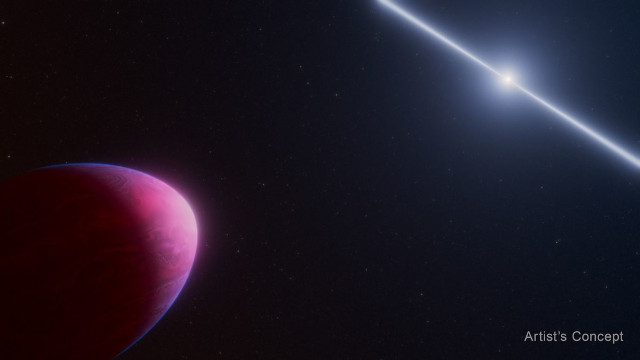
Artist's concept of the of the exoplanet PSR J2322-2650b and its pulsar (Image NASA, ESA, CSA, Ralf Crawford (STScI))

An article published in The Astrophysical Journal Letters reports the results of a study of a gas giant exoplanet cataloged as PSR J2322-2650b, which has a completely abnormal atmosphere composed above all of helium and carbon. A team of researchers used observations conducted with the James Webb Space Telescope to study the atmosphere of this exoplanet, which has a mass similar to Jupiter’s and has a distance from its star that is only one-hundredth of the Earth’s distance from the Sun. The star is a pulsar, adding another unusual element to the system. PSR J2322-2650b can’t be explained by current models of planetary formation.

The capsule of the Soyuz MS-27 spacecraft after landing (Image NASA+)

A few hours ago, cosmonauts Sergey Ryzhikov and Alexey Zubritsky and astronaut Jonny Kim returned to Earth on the Soyuz MS-27 spacecraft, which landed in Kazakhstan. They had reached the International Space Station on April 8, 2025, as part of a normal crew rotation. The capsule landed on its side, an event that can occur due to reentry conditions, but the crew members suffered no injuries.

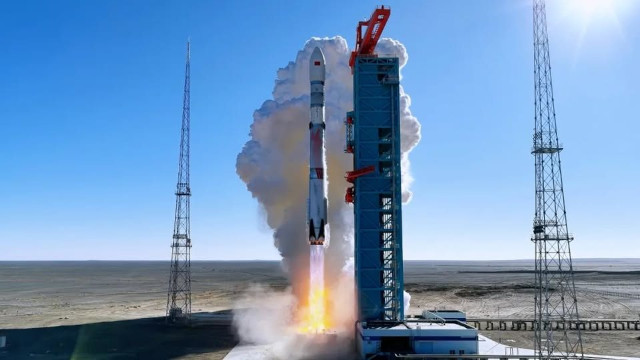
The Zhuque-3 Y1 rocket blasting off (Photo courtesy LandSpace)

A few hours ago, the Chinese Zhuque-3 Y1 rocket blasted off from the Dongfeng commercial space innovation pilot zone, carrying a mass simulator consisting of a prototype of the Haolong cargo spacecraft, currently under development. The second stage successfully reached orbit with payload separation, achieving a successful primary mission upon its debut. LandSpace, the company that developed the rocket, aimed to land the first stage, but this failed due to an anomaly during the reenter maneuvers.