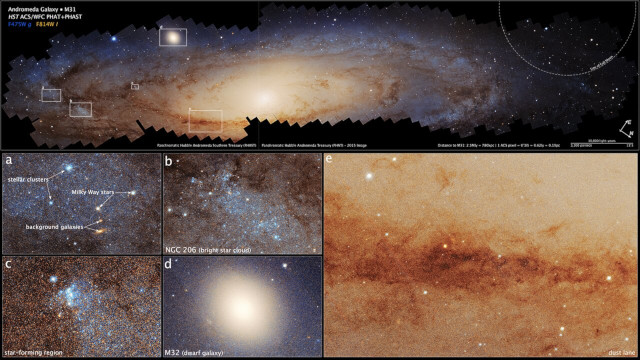
A new image (NASA, ESA, B. Williams (University of Washington)) of the Andromeda Galaxy has been created by combining images captured by the Hubble Space Telescope from about 600 separate fields of view. It took two observing programs over a total of more than a decade and a thousand Hubble orbits to achieve this result. The new mosaic includes more than two hundred million individual stars in the Andromeda Galaxy, a minority made up of the stars that are more massive and bright than the Sun. Hubble’s observations provide a wealth of information about these stars that helps us better understand Andromeda’s history.
Almost exactly a century ago, astronomer Edwin Hubble succeeded in proving that Andromeda was a galaxy just like the Milky Way, marking a revolution that went beyond the world of astronomy since it established that the universe was much larger than previously thought. It seems fitting that the space telescope named after the famous astronomer was used to conduct the colossal work necessary to create the new mosaic.
The total number of stars in the Andromeda Galaxy is estimated to be around a trillion, but even Hubble cannot resolve all the stars that are smaller and fainter than the Sun. Its relative proximity to the Milky Way, “only” about 2.5 million light-years away, helps only to a certain extent in observing individual stars.
The apparent size of the Andromeda Galaxy as seen from Earth or from its orbit makes it much larger than the objects normally observed by the Hubble Space Telescope. For this reason, it was necessary to obtain over 600 photos to assemble.
This enormous effort began a decade ago with the Panchromatic Hubble Andromeda Treasury (PHAT) program, which produced images at ultraviolet, visible, and near-infrared wavelengths using the Advanced Camera for Surveys (ACS) and Wide Field Camera (WFC3) instruments. Subsequently, the Panchromatic Hubble Andromeda Southern Treasury (PHAST) program added images of about a hundred million stars in Andromeda’s southern half.
The result brings a lot of information about Andromeda galaxy’s stars such as their age, the abundance of elements heavier than hydrogen, and helium and their masses. All this information is useful in reconstructing the history of Andromeda, which could be very different from that of the Milky Way despite their similarities.
The Andromeda galaxy seems to be more populated by young stars with unusual characteristics than the Milky Way. According to astronomers, it’s a galaxy in transition from a spiral in which stars are forming to an elliptical galaxy dominated by ancient stars. It seems that there were relatively recent galaxy interactions, and the satellite galaxy M32 could be at least one of the culprits since it seems to be the core of what used to be a galaxy that interacted with Andromeda, which stole stars and gas from it.
The information obtained is valuable for analysis and other astronomical studies that use it directly but also to support future observations by the James Webb Space Telescope, which has much greater power and sensitivity at infrared. When NASA’s Nancy Grace Roman Telescope is launched, according to plans in 2027, astronomers will also be able to use this information for observations by this new space telescope, which will be able to take the equivalent of at least a hundred high-resolution images from Hubble in one go.
One of the images published, here at the bottom (NASA, ESA, B. Williams (University of Washington)), shows some interesting parts of the Andromeda Galaxy: clusters of bright blue stars with other galaxies in the background (a), the NGC 206 star cloud (b), a young cluster of newborn blue stars (c), the M32 satellite galaxy (d), and dark lanes of dust across myriads stars (e).
Andromeda has been a model for studying galaxies for a century. Correctly reconstructing its history, also by understanding which mergers and interactions have occurred, is essential for perfecting cosmological models. This will also help us better understand the evolution of the Milky Way.