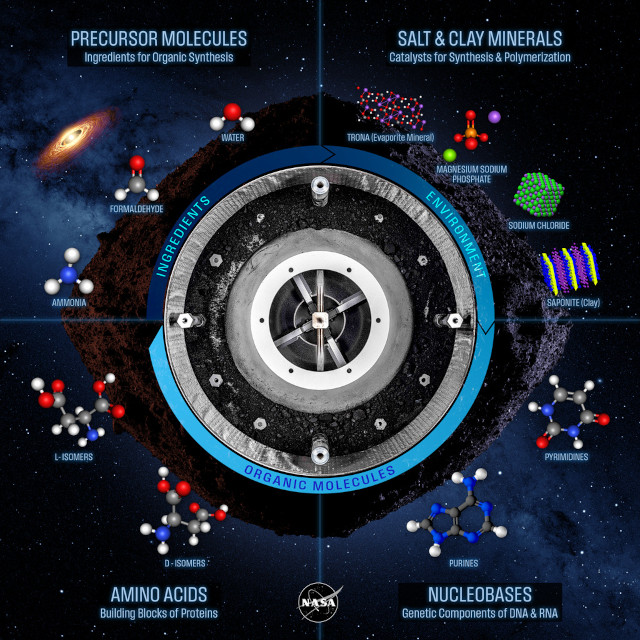
Two articles, one published in the journal “Nature” and one in “Nature Astronomy” report the results of examinations of samples from asteroid Bennu with the discovery of the presence of all the DNA and RNA bases and 14 of the 20 amino acids present on Earth. Two teams of researchers analyzed these samples, which were collected by NASA’s OSIRIS-REx space probe, which brought them back to Earth. Building blocks of life were also found in samples from the asteroid Ryugu brought back to Earth by the Hayabusa 2 space probe and the ones found in the samples brought back from Bennu offer new confirmation that the Earth may have been “seeded” by asteroids.
The OSIRIS-REx space probe completed its mission on September 24, 2023, with the arrival on Earth of the samples collected in previous years on asteroid Bennu. There’s a collaboration with the Japanese mission Hayabusa 2 and consequently some samples were analyzed by a team led by Daniel Glavi of NASA’s Goddard Space Flight Center that includes Japanese members who had already analyzed samples from asteroid Ryugu such as Professor Yasuhiro Oba of Hokkaido University.
The results of this international collaboration have been published in “Nature Astronomy” with extraordinary results since they discovered thousands of organic compounds. The most important compounds are certainly adenine, guanine, cytosine, thymine, and uracil, which are the bases of DNA and RNA. The presence of 14 of the 20 amino acids present on Earth is also important since they’re also involved in life processes.
Another interesting result is in the orientation of the amino acid molecules since several of them can form with a right or left orientation. Both orientations were found in equal amounts in Bennu’s samples, so this discovery doesn’t explain why Earth’s life forms use left-handed amino acids.
The results published in “Nature” by a team led by Timothy McCoy of the Smithsonian Institution’s National Museum of Natural History, USA, may seem less important but are still interesting from various points of view. It’s about salts of different types that include phosphates that contain sodium and carbonates, sulfates, chlorides, and sodium-rich fluorides. According to the researchers, they formed when a brine evaporated and this offers clues to the type of water that was present in the object from which asteroid Bennu formed.
Various types of brine have been detected in the solar system in places such as the dwarf planet Ceres, where liquid water may have existed in ancient times, and Enceladus, Saturn’s moon that still has a subsurface ocean of liquid water. Water is abundant in the solar system, so it’s not surprising that it could be present in an object where chemical reactions occurred that formed salts and perhaps even organic compounds that ended up in its remains, including Bennu. The discovery of phosphates announced in 2024 suggests that Bennu was ejected from a primitive world with an ocean.
The discovery of all these compounds in asteroid Bennu, illustrated in the bottom infographic (NASA Goddard/OSIRIS-REx/Dan Gallagher), suggests more than ever that life’s building blocks didn’t form on Earth but elsewhere, perhaps on asteroids such as Bennu or perhaps on larger objects such as the one from which Bennu originated, and then reached Earth. Each study of the samples collected offers new information but there are still many questions and analyses continue to obtain answers. The results will help better understand the origin of life on Earth and the history of the solar system.