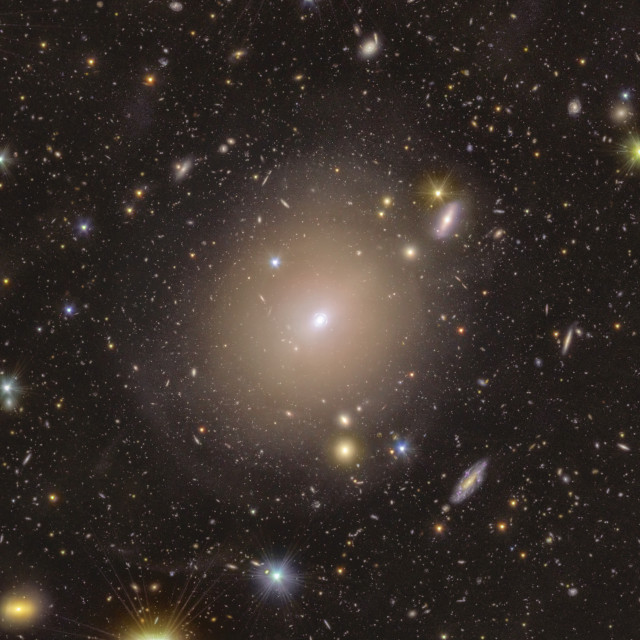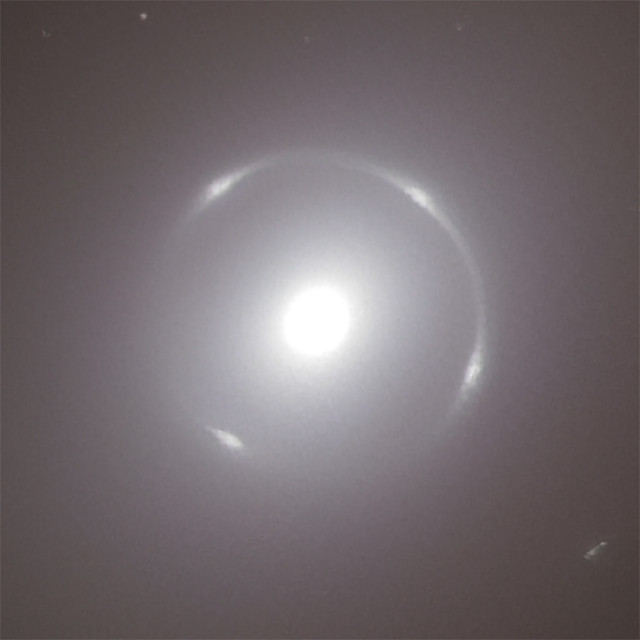
An article published in the journal “Astronomy & Astrophysics” reports the identification of a practically perfect so-called Einstein ring around the galaxy NGC 6505. A team of researchers Conor led by O’Riordan of the Max Planck Institute for Astrophysics in Munich, Germany, examined observations conducted with the Euclid space telescope to study the image of a much more distant galaxy distorted by the gravitational lens created by NGC 6505. This effect allows to study NGC 6505 as well because its mass creates that gravitational lens, so its effects allow to analyze it.
Launched on July 1, 2023, the Euclid space telescope was designed by ESA to study cosmological mysteries such as dark matter and dark energy. Gravitational lenses are important in this type of research because they are created by the gravitational force of individual galaxies or galaxy clusters and their effects enable the study of the distribution of matter in those galaxies. Each gravitational lens studied offers new information that is potentially valuable in the study of dark matter.
Images distorted by gravitational lenses usually show irregularities but this depends on the distribution and density of matter in the galaxy or group of galaxies that create those lenses. In a few lucky cases, the alignment of the object that creates the lens and the galaxy behind it from the point of view of the Earth allows a circular or almost circular shape to be obtained. This shape is called an Einstein ring because the gravitational lensing effect was predicted by Albert Einstein’s general theory of relativity.
Gravitational lenses are important in the Euclid mission but the one created by the galaxy NGC 6505 was discovered by chance during the space telescope’s testing phase. The first images were out of focus and yet ESA scientist Bruno Altieri noticed the Einstein ring. This discovery is curious because it concerns a galaxy discovered in 1884 that has been observed with who knows how many different instruments that have become increasingly more perfect, and yet this Einstein ring around it was never detected. This confirms Euclid’s remarkable power.
Astronomers had already measured the distance of the galaxy NGC 6505 in the past at about 590 million light-years from Earth and therefore in the nearby universe. The galaxy behind it that formed the Einstein ring has a distance that was estimated at about 4.2 billion light-years from Earth and therefore much further away.
The Einstein ring around the galaxy NGC 6505 has four slightly brighter areas where the image of the more distant galaxy appears sharper. In other cases of images detected thanks to a gravitational lens, only that type of repeated image exists and in that case, the result is called an Einstein cross.
The authors of the study on this Einstein ring proposed the nickname Altieri ring after the scientist who discovered it. The fact that it was discovered in the Euclid mission’s test images is encouraging for the search for other gravitational lenses also considering that many of them have weaker and therefore less evident effects. All of these discoveries will be useful in the investigation of dark matter but in some cases, they can also offer spectacular images.