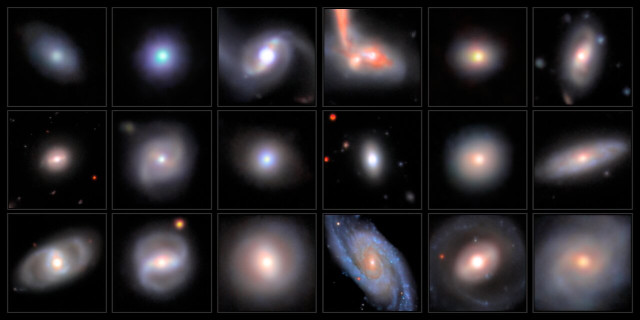
An article to be published in “The Astrophysical Journal” reports the discovery of about 2,500 new candidate active galactic nuclei in dwarf galaxies and about 300 new candidate intermediate-mass black holes (Mosaic images: Legacy Surveys/D. Lang (Perimeter Institute)/NAOJ/HSC Collaboration/D. de Martin (NSF NOIRLab) & M. Zamani (NSF NOIRLab)). A team of researchers examined observations conducted with the Dark Energy Spectroscopic Instrument (DESI) on the Nicholas U. Mayall 4-meter Telescope in Arizona to find all these possible black holes.
This is just the initial phase of DESI’s data collection, as this study is based on the DESI Early Data Release (EDR), released on June 13, 2023. For this reason, the result is very exciting, as it has already indicated that many more dwarf galaxies could have an active galactic nucleus than previously estimated, and has identified many new possible black holes of the most elusive type.
Because they are much less massive than ordinary galaxies, it was estimated that only 0.5% of dwarf galaxies could host a black hole massive enough to power an active galactic nucleus. In short, according to these estimates, that type of activity is rare in dwarf galaxies compared to common galaxies, which normally have supermassive black holes that can be surrounded by large masses of gas and dust.
Now a team led by Ragadeepika Pucha, a postdoctoral researcher at the University of Utah, has examined a set of observations of about 410,000 galaxies that include about 115,000 dwarf galaxies and found about 2,500 candidate active galactic nuclei. This is a much higher percentage than estimated. Sure, for now those identified are candidates but their quantity is truly remarkable.
That research also identified about 300 new candidate intermediate-mass black holes. They are halfway between stellar-mass black holes and supermassive black holes, two categories that are fairly well known whereas the one in the middle has remained elusive until now. In recent years, several intermediate-mass black hole candidates have been found but they’re still poorly understood. 70 of the new candidates are among the ones in dwarf galaxies but there are many others.
The possibility of examining 300 new candidates will help to investigate the nature of intermediate-mass black holes. They could be a sort of fossils left over from the formation of the first black holes in the universe and the seeds of supermassive black holes existing at the centers of ordinary galaxies. One of the questions concerns the possible relationship between the mechanism of their formation and the type of galaxy that hosts them. This type of question is also linked to the evolution of this type of black hole.
The DESI instrument was designed for cosmological investigations, in particular the ones connected to the expansion of the universe and the hypothesis of dark energy that is accelerating it. This makes it very useful also in studies such as that of black holes. The amount of candidates found in the DESI Early Data Release offers a lot of information to study and researchers expect that future releases will include even more information to further expand this type of study.