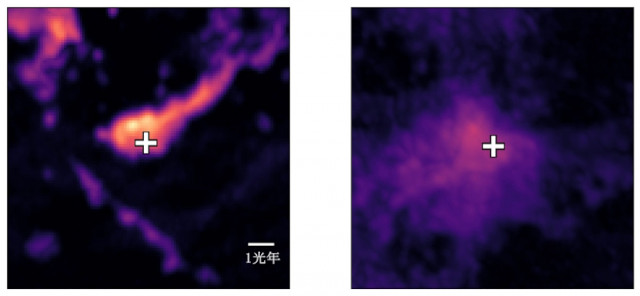
An article published in “The Astrophysical Journal” reports a study of 17 molecular clouds in the Small Magellanic Cloud, one of the Milky Way’s satellite dwarf galaxies. A team of researchers led by Kazuki Tokuda, a postdoctoral researcher at Kyushu University, Japan, examined high-resolution images captured using the ALMA radio telescope to obtain information on their characteristics. The examination showed that 40% of those clouds had a more diffused gas, with fluffy structures. The others were classic molecular clouds with a filamentary structure that are also found in the Milky Way. This difference was attributed to the scarcity of elements heavier than hydrogen and helium in the Small Magellanic Cloud, a situation similar to that of the early universe.
The top image (ALMA (ESO/NAOJ/NRAO), Tokuda et al., ESA/Herschel)) shows the Small Magellanic Cloud as seen by ESA’s Herschel space telescope. The circles indicate the locations where the ALMA radio telescope observed the molecular clouds, magnified in the insets.
In the Milky Way, stars are born in molecular clouds in which gas is concentrated in filaments about a third of a light-year across. The Sun also formed in such a cloud, but five billion years ago, generations of stars had already produced a large amount of elements heavier than hydrogen and helium.
Astronomers have wondered how stars formed in the early universe, but the oldest galaxies are too far away to obtain sufficient detail. Until recently, it wasn’t possible to obtain sufficient detail even in a dwarf galaxy that in astronomical terms is very close. However, now the ALMA radio telescope can provide high-quality detections, and the authors of this study were able to study molecular clouds in the Small Magellanic Cloud, which are chemically similar to the clouds that existed in the early universe.
Both filamentary and fluffy molecular clouds were found in the Small Magellanic Cloud, allowing the researchers to analyze the consequences of that structural difference on the star formation within them. A difference in temperature was also detected in the two types of molecular clouds, with the filamentary ones being warmer than the fluffy ones.
The researchers concluded that filamentary clouds are more likely to be the home to low- to medium-mass stars like the Sun. That’s because the filaments break up into a stellar egg, also called a molecular cloud core. Over hundreds of millennia, gravity pulls gas and material into the cores to create small- to medium-mass stars. However, the fluffy structures make it difficult for those types of stars to form.
As the clouds cool, the kinetic energy of the gas inside them likely generates turbulences and smooths out the structure, resulting in the fluffy appearance that was compared to cotton candy. Young, massive stars can maintain warmer temperatures. The presence of heavy elements appears to help maintain the filamentary structures and might be important in the formation of planets.
The researchers observed various processes at work as masses of gas collide and stars form, and understanding how they shape the structure of a molecular cloud is a topic that will require further study. Kazuki Tokuda’s team intends to compare the results obtained from the study on the Small Magellanic Cloud with observations of molecular clouds that exist in galaxies rich in heavy elements such as the Milky Way. The aim is to improve our knowledge of star formation processes with a focus on what happened in the early universe and what still happens in environments poor in heavy elements.
The bottom image (ALMA (ESO/NAOJ/NRAO), Tokuda et al.) shows an example of a filamentary molecular cloud on the left and a fluffy cloud on the right in the Small Magellanic Cloud.