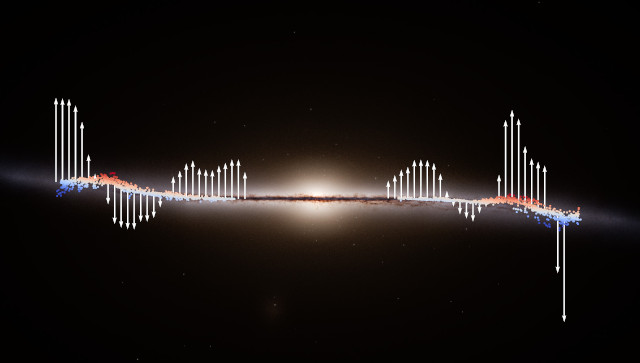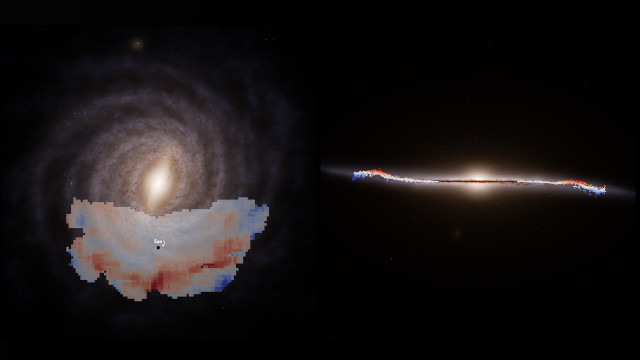
An article published in the journal “Astronomy and Astrophysics” reports the results of a study that provides evidence that a sort of giant cosmic wave is crossing the Milky Way, propagating from the center outward from the galactic disk, causing a corrugation. A team of researchers led by Eloisa Poggio of the Italian National Institute for Astrophysics used data collected by ESA’s Gaia space probe to map the motions of thousands of young giant stars and Cepheids within the corrugation, reconstructing the wave that generates them. The cause may be the aftermath of an ancient collision with a dwarf galaxy, but follow-up studies are needed to assess this and other possible explanations.
The top image (ESA/Gaia/DPAC, S. Payne-Wardenaar, E. Poggio et al. (2025). ESA standard license) shows the cosmic wave in red and blue, with stars above the galactic disk in red and the ones below it in blue. On the left, the Milky Way is seen from above, with the Sun indicated by the black dot. On the right, the Milky Way is seen edge-on, showing that one side is warped upward and the other downward due to the cosmic wave.
Over the past few decades, astronomers have discovered various motions within the Milky Way, in addition to the rotation of the stars around its center. Recently, the Gaia space probe has collected a treasure trove of precise information about the galaxy’s stars, allowing researchers to reconstruct its internal dynamics. What is emerging is a galaxy with various motions and perturbations.
A major problem in studying the Milky Way is that we can only conduct observations from within it. On the other hand, the relative proximity of its stars allowed a specialized space telescope like the Gaia space probe’s to observe them with a precision impossible with stars outside it.
A decade of data collected by the Gaia space probe allowed Eloisa Poggio’s team to study a sample of about 17,000 young giant stars and about 3,400 Cepheids, variable stars whose brightness varies predictably. The mapping created using data on the motions of these stars allowed them to reconstruct the gigantic wave, which generates what can be considered a corrugation in the galactic disk as it moves outward from the center of the Milky Way.
The observations concern stars, but the researchers think that the gas in the galactic disk also moves with this wave. This suggests that the gas that formed the studied stars influenced their motion within the wave. The so-called Radcliffe wave is also composed of gas and is enormous in absolute terms, extending across several thousand light-years. However, it’s much smaller than the wave described in this study and is located in a different area of the galaxy. It’s unclear whether there’s a correlation between these waves, and future studies may attempt to establish this.
The origin of this great wave is also unclear. It could be the consequence of an ancient collision between the Milky Way and a dwarf galaxy, and several studies have described the perturbations generated by the Sagittarius Dwarf Elliptical Galaxy, one of the Milky Way’s satellite dwarf galaxies. However, follow-up studies will be needed to verify this theory.
The Gaia space probe mission ended in March 2025, but the data collected continues to be cataloged, and the last so-called Data Release, scheduled for being released in December 2026, will offer even greater precision regarding the positions and motions of the Milky Way’s stars. This will further refine the mapping of perturbations like the great cosmic wave at the center of this study. Reconstructing the Milky Way’s current dynamics will help reconstruct its history as well.
The bottom image (ESA/Gaia/DPAC, S. Payne-Wardenaar, E. Poggio et al (2025). ESA Standard License) shows the Milky Way edge-on with arrows indicating the motions of the stars. The peak of the upward motions is slightly shifted from the physical distortion indicated by the red and blue colors.