
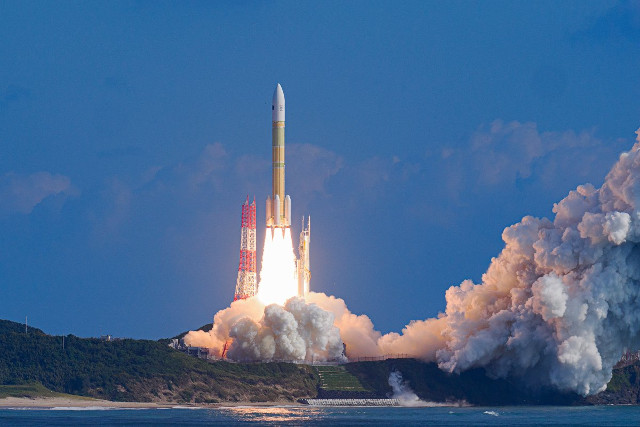
A few hours ago, the HTV-X1 spacecraft blasted off atop a H3-24W rocket from the Tanegashima space center in Japan for a resupply mission to the International Space Station. A little more than 14 minutes after the launch, the cargo spacecraft separated regularly from the rocket’s last stage, entered its preliminary orbit, and deployed its solar panels and navigation antennas. It’s the new Japanese cargo spacecraft HTV-X’s maiden launch.
The HTV-X cargo spacecraft is based on the older HTV, with several modifications designed to lighten the spacecraft while simultaneously increasing the payload that can be launched. In particular, the capacity to accommodate cargo in the unpressurized module was increased. The design changes are also intended to reduce costs through design simplification.
The development of this new cargo spacecraft was long and complex. The initial design called for the first HTV-X launch in 2022. The design passed through several changes over the years, which contributed to the delays of this maiden launch.
The launch vehicle used by the Japanese cargo spacecraft has also changed. The old H-IIB rocket was replaced by the new H3, which was successfully launched for the first time in February 2024. The rocket that launched HTV-X1 is an H3-24W, meaning it’s configured with two LE-9 liquid hydrogen/oxygen engines on its first stage, four solid-fuel side boosters, and a wide fairing.
The cargo carried by the HTV-X1 spacecraft includes supplies such as water and food for the International Space Station crew, as well as various scientific experiments. Among these, several were created by private companies and sent to the International Space Station through an existing commercial utilization program with JAXA.
The HTV-X1 spacecraft was placed on a route that takes almost four days, similar to its predecessor, the HTV. Therefore, its arrival at the International Space Station is scheduled for Wednesday, October 29, around 15:50 GMT. It will be captured by the Canadarm2 robotic arm, like the American Dragon and Cygnus cargo ships.
