
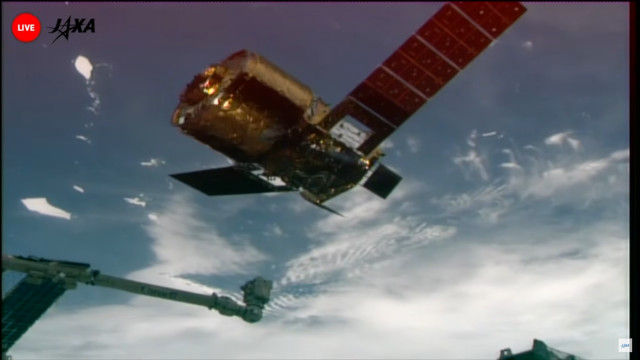
A little while ago, the HTV-X1 spacecraft was captured by the International Space Station’s Canadarm2 robotic arm, operated by astronaut Kimiya Yui. The Japanese space cargo ship, which blasted off when it was Sunday in Japan, carries a huge amount of supplies and experiments. After its capture, they started the slow moving of the HTV-X1 to its berthing location on the Harmony module, where it will be safely installed.
The HTV-X1 cargo spacecraft was captured by the Canadarm2 robotic arm, just as happened in previous years with the older HTV cargo spacecraft. However, JAXA is planning to use an automatic docking system in the future, which could be used as early as next year on the next HTV-X cargo spacecraft mission.
This type of development was conducted by SpaceX mainly for the astronaut-carrying version of its Dragon spacecraft, to reduce travel time. For a cargo spacecraft, a few extra hours before docking with the International Space Station makes no difference, but this type of development is beneficial to the Station’s crew, as there’s no need for someone to operate the Canadarm2.
The HTV-X1 cargo spacecraft mission will last up to six months, but JAXA may decide to have it depart the International Space Station as early as January 2026. At that point, it will be able to conduct another mission consisting of experiments and demonstrations of new onboard technologies.
The International Space Station is sometimes used as a platform to launch nanosatellites. On its second mission, the HTV-X1 cargo spacecraft will ascend to a higher orbit, demonstrating its ability to launch microsatellites and nanosatellites. This altitude will allow them to take longer to decay from their orbits. The ability to conduct longer missions could be useful in various studies conducted from orbit using very small satellites.
The launch tests of very small satellites are just a small part of the next HTV-X1 cargo spacecraft mission. JAXA intends to use this spacecraft as a sort of space laboratory for months. This is one of the developments of the Japanese space program, which also includes the possibility of using HTV-X cargo spacecraft as part of the Artemis program.
