November 2025

The crew of the Soyuz MS-28 spacecraft: Chris Williams, Sergey Kud-Sverchkov, and Sergey Mikaev (Photo courtesy of GCTC)

A few hours ago, the Soyuz MS-28 spacecraft was launched from the Baikonur Cosmodrome in Kazakhstan and, after a little more than three hours, reached the International Space Station with three new crew members on board. It docked with the Station’s Rassvet module. The ultra-fast track was used, which halves the journey duration and is used whenever the Station’s position makes it possible.

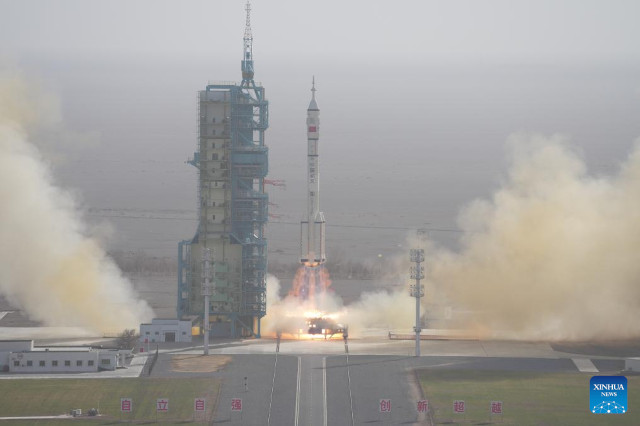
The Shenzhou 22 spacecraft blasting off atop a Long March-2F rocket (Photo courtesy Li Minggang/Xinhua)

Confirmation has arrived that the Shenzhou 22 spacecraft has reached the Tiangong space station with an automated docking maneuver. It launched with no crew aboard about 3.5 hours earlier atop a Long March-2F rocket from the Jiuquan Satellite Launch Center. The Shenzhou 22 was sent to the Tiangong to provide the Shenzhou 21 mission crew with a reliable vehicle to return to Earth.

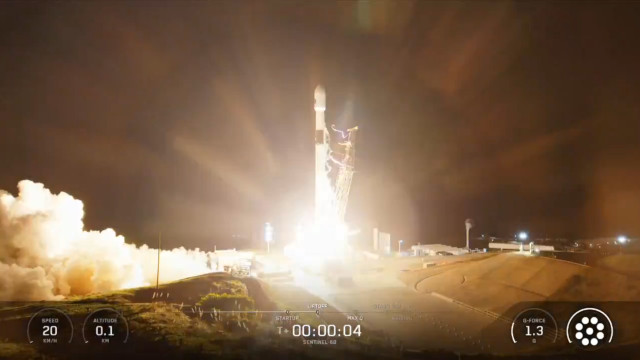
The Sentinel-6B satellite blasting off atop a Falcon 9 rocket (Image courtesy SpaceX)

A few hours ago, the Sentinel-6B satellite was launched atop a Falcon 9 rocket from the Vandenberg base. After about 57 minutes, it successfully separated from the rocket’s last stage and set off on its course to reach the polar orbit at 1,336 kilometers altitude where its scientific mission will begin, taking over from the Sentinel-6A Michael Freilich satellite, which was launched on November 21, 2020.

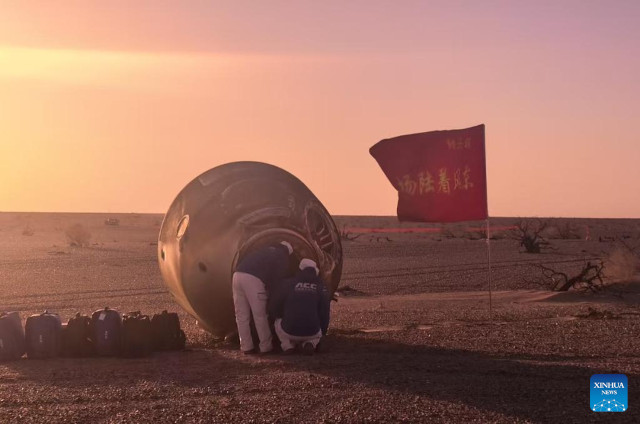
The Shenzhou 21 capsule after landing (Photo courtesy Wang Jiangbo/Xinhua)

A few hours ago, the three Chinese taikonauts from the Shenzhou 20 mission returned to Earth after spending 204 days on the Tiangong space station, where they arrived on April 24, 2024. The three taikonauts—Chen Dong, Chen Zhongrui, and Wang Jie—had left the station about 3.5 hours earlier to land at a site called Dongfeng in China’s Inner Mongolia Autonomous Region. The three taikonauts returned aboard the Shenzhou 21 spacecraft because the Shenzhou 20 spacecraft suffered tiny fractures in a window following the impact of what was likely space debris and was deemed unsafe for human transportation.

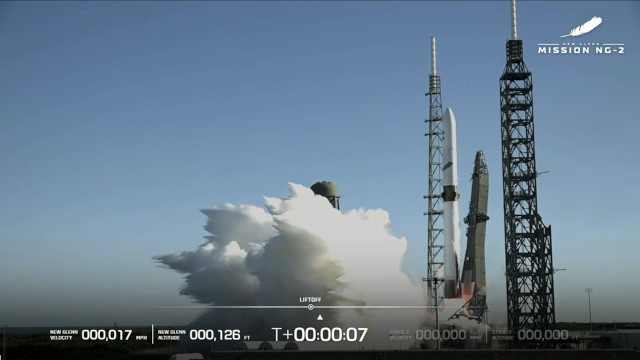
The ESCAPADE twin probes blasting off atop a New Glenn rocket (Image courtesy Blue Origin)

A few hours ago, NASA’s ESCAPADE (Escape and Plasma Acceleration and Dynamics Explorers) twin probes were launched atop a Blue Origin New Glenn rocket, which accomplished its mission, called NG-2. One goal for Blue Origin was to land the first stage, which was a successful one just over 9 minutes after launch. After approximately 33 minutes, the probes, named Blue and Gold, separated from the rocket’s second stage and began a long journey to Mars to study its magnetosphere and the Sun’s impact on the red planet.