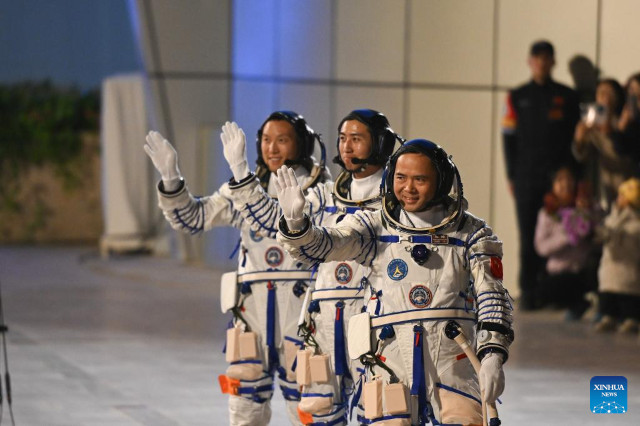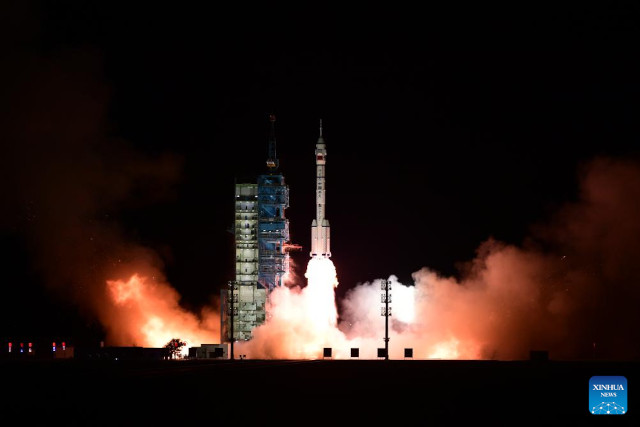
A confirmation has arrived that three Chinese taikonauts from the Shenzhou 21 mission reached the Chinese space station Tiangong with an automated docking maneuver. They blasted off about 3.5 hours earlier atop a Long March-2F rocket from the Jiuquan Satellite Launch Center. They form the 10th crew of the Chinese space station and will remain there for about six months, the standard duration for a mission.
The Shenzhou 21 spacecraft took about 3.5 hours to reach the Tiangong space station. This ultra-fast trace nearly halves the flight time compared to the previous Shenzhou 20 mission. This is the first time this route was used, which represents a further advance in the travels of the taikonauts and was adopted after careful preparations.
The Tiangong space station performed two orbital correction maneuvers to position itself in the correct position that enabled the Shenzhou 21 spacecraft to use the ultra-fast trace. This is because this type of route requires remarkable precision maneuvers and positioning the space station on the right trajectory.
The three taikonauts, as the Chinese call their astronauts, on the Shenzhou 21 mission are Zhang Lu, Wu Fei, and Zhang Hongzhang. The identities of the crew members were revealed only at the last minute, but the information made available is a bit more extensive than previously, especially considering that only Zhang Lu is a veteran taikonaut.
Mission commander Zhang Lu was born in 1976 in Hanshou County. He enlisted in the Chinese Air Force, where he became a pilot, and was selected as a taikonaut in 2010. He’s a senior colonel who previously served on the Tiangong Chinese space station on the Shenzhou 15 mission, the first crew to arrive after its completion.
Wu Fei. Born in 1993 in Baotou, Inner Mongolia, he graduated from the Beijing University of Aeronautics and Astronautics in 2014 and earned a master’s degree in 2017, specializing in life support systems design. After enlisting in the Chinese military, he worked as an engineer for the China Aerospace Science and Technology Corporation (CASC). In September 2020, he was selected as a taikonaut. He’s the youngest taikonaut to go into orbit.
Zhang Hongzhang. Born in 1986 in Linchi City, Shandong Province, he graduated with a degree in chemical engineering from Shandong University in 2008 and earned a Ph.D. from the Dalian Institute of Physical Chemistry in 2013. He worked as a researcher for some years before being selected as a taikonaut in September 2020.
The taikonauts of the Shenzhou 20 mission will return to Earth in a few days, so they met with their replacements from the Shenzhou 21 mission, and the two crews will work together for a few days. This practice allows the station to be constantly crewed and has now become routine.
In addition to the human crew, the Shenzhou 21 spacecraft carried four mice, two males and two females, which will be raised in orbit to study their behavior in the Tiangong space station’s microgravity. They will be returned to Earth aboard the Shenzhou 20 spacecraft for examination and further medical information that could be useful for humans.
The Chinese authorities never reveal much about the activities conducted by taikonauts on the Tiangong space station beyond general information on scientific experiments, educational activities conducted for Chinese students, outreach to the general public, and possible spacewalks.
The Chinese space program continues to make progress. China’s ambitions in space must be taken seriously, so much so that, for example, it’s unclear whether American astronauts will return to the Moon before some taikonauts arrive there.