
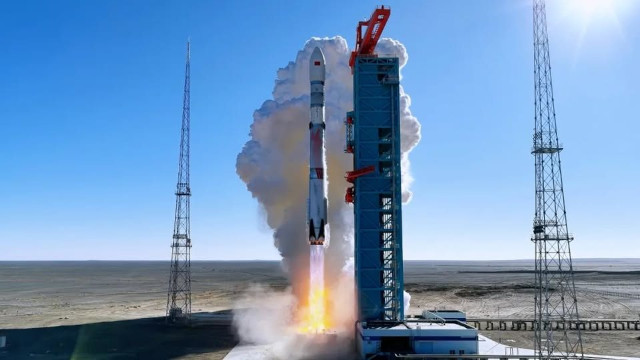
A few hours ago, the Chinese Zhuque-3 Y1 rocket blasted off from the Dongfeng commercial space innovation pilot zone, carrying a mass simulator consisting of a prototype of the Haolong cargo spacecraft, currently under development. The second stage successfully reached orbit with payload separation, achieving a successful primary mission upon its debut. LandSpace, the company that developed the rocket, aimed to land the first stage, but this failed due to an anomaly during the reenter maneuvers.
About a decade after SpaceX’s first successful landing of the Falcon 9 rocket’s first stage, other companies are attempting the same feat. Blue Origin achieved the feat a few weeks ago with its New Glenn rocket. In recent years, China has taken this goal very seriously, and there are three Chinese partially reusable rockets in various stages of development. After several delays, the Zhuque-3 rocket has finally achieved its maiden launch.
The Zhuque-3 rocket can be compared to the Falcon 9 in terms of its size and payload-to-orbit capacity. The big difference is that it uses methane and liquid oxygen-fueled engines, like SpaceX’s Super Heavy and Blue Origin’s New Glenn.
The Zhuque-3 Y1 rocket, the one used for the maiden flight, accomplished its primary mission by delivering the cargo into orbit. Information available during the launch preparation period indicated that the payload was a prototype of the Haolong cargo spacecraft. This is a new version of the cargo spacecraft used by the Chinese to transport supplies to the Tiangong space station. In this respect, too, the Chinese are making progress, in the sense that Haolong will be a reusable cargo ship.
Landing the first stage of the Zhuque-3 Y1 rocket was an important goal, but it failed. From the limited information available, it appears that there was an abnormal combustion during the descent maneuvers, which made a controlled landing impossible.
In the end, the Zhuque-3 rocket’s maiden flight was half successful. Neither SpaceX nor Blue Origin succeeded on their first attempts to land the first stages of the Falcon 9 and New Glenn. There’s certainly disappointment in China, especially among the LandSpace team, but equally there’s the awareness that success is now within reach and the rocket’s systems must be fine-tuned to achieve it. All that remains is to await the next attempts and the debut of the other partially reusable Chinese rockets currently under development.
