2025

The Dragon 2 cargo spacecraft blasting off atop a Falcon 9 in its CRS-32 mission (Image NASA+)

A little while ago, the SpaceX Dragon 2 spacecraft blasted off atop a Falcon 9 rocket from Cape Canaveral in its CRS-32 (Cargo Resupply Service 32) mission, also referred to as SPX-32. After almost 10 minutes, it separated successfully from the rocket’s last stage and went en route. This is the 32nd mission for the Dragon/Dragon 2 spacecraft to resupply the International Space Station with various cargoes and then return to Earth, again with various cargoes.

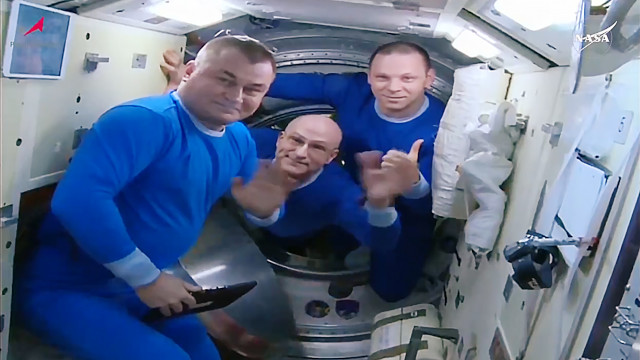
Alexey Ovchinin, Don Pettit and Ivan Vagner enter the Soyuz MS-26 spacecraft (Image NASA+)

A few hours ago, cosmonauts Alexey Ovchinin and Ivan Vagner and astronaut Don Pettit returned to Earth on the Soyuz MS-26 spacecraft, which landed in Kazakhstan. They had reached the International Space Station on September 11, 2024, as part of a crew rotation that has returned to normal after some time.

On Friday, April 18, Alexey Ovchinin officially handed over command of the International Space Station to Japanese astronaut Takuya Onishi. The launch of the Soyuz MS-26 spacecraft marked the start of Expedition 73.

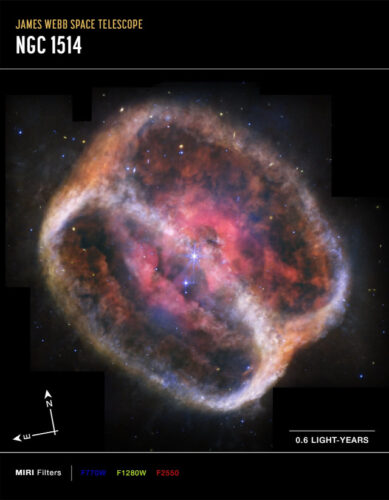
Planetary Nebula NGC 1514 (MIRI image, annotated)

An image captured by the James Webb Space Telescope depicts NGC 1514, a planetary nebula with a dying star at its center. The MIRI (Mid-Infrared Instrument) captured details never seen before, especially of the rings visible only in infrared. The dying star has a companion, although in the images, it seems that thre’s a single bright star at the center of the nebula. This show will continue for many more millennia before the materials disperse into interstellar space. In the meantime, the dying star already only has a compact core left in the form of a white dwarf.

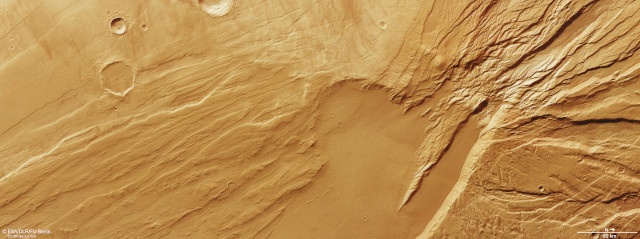
The area around the Acheron Fossae region on Mars

ESA has released images of the Acheron Fossae region on Mars captured by its Mars Express space probe’s High Resolution Stereo Camera (HRSC). The peculiarity of these images is that they show the two faces of Mars, meaning that they show how the red planet is basically divided into two parts with very different geological characteristics. About half of Mars is composed of an ancient terrain marked by craters and other signs of age and activity, while the other half is much smoother, with a surface probably reshaped by lava from volcanoes that are no longer active.