
2025

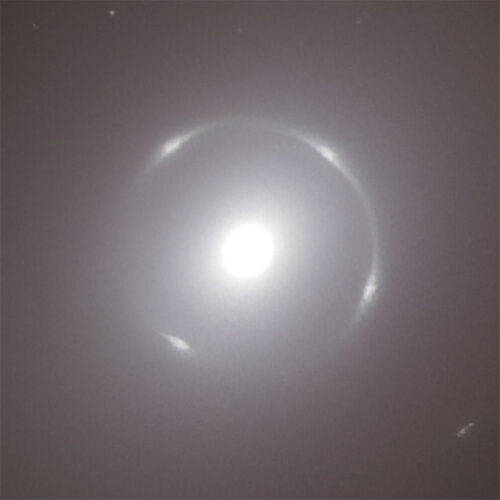
The Einstein ring around galaxy NGC 6505 (Image ESA/Euclid/Euclid Consortium/NASA, image processing by J.-C. Cuillandre, G. Anselmi, T. Li / CC BY-SA 3.0 IGO)

An article published in the journal “Astronomy & Astrophysics” reports the identification of a practically perfect so-called Einstein ring around the galaxy NGC 6505. A team of researchers Conor led by O’Riordan of the Max Planck Institute for Astrophysics in Munich, Germany, examined observations conducted with the Euclid space telescope to study the image of a much more distant galaxy distorted by the gravitational lens created by NGC 6505. This effect allows to study NGC 6505 as well because its mass creates that gravitational lens, so its effects allow to analyze it.

The galaxy LEDA 131342

An article published in “The Astrophysical Journal Letters” reports a study of the galaxy LEDA 131342 that identified nine concentric rings composed of stars that make it look like a sort of cosmic bullseye. A team of researchers used the Hubble Space Telescope and the Keck Observatory in Hawaii to identify these rings that form a truly extraordinary configuration considering that so far, galaxies with only two or three rings were known. The cause of this unique conformation is a dwarf galaxy that, according to calculations, about 50 million years ago passed through LEDA 131342 drastically changing its original shape.

Scheme of the the HD 20794 system with its habitable zone in green (Image courtesy Gabriel Pérez (IAC))

An article published in the journal “Astronomy & Astrophysics” reports the identification of the exoplanet that was cataloged as HD 20794 d. A team of researchers used data collected in more than twenty years with two spectrographs: ESPRESSO, mounted on the VLT, and HARPS, at the La Silla Observatory, both of ESO in Chile, to identify HD 20794 d and define its orbit and characteristics. The analysis indicates that it’s a super-Earth with a mass almost six times the Earth’s with a highly elliptical orbit that brings it into the habitable zone of its star system for part of its year.

A sample from asteroid Bennu (Photo courtesy Yasuhiro Oba)

Two articles, one published in the journal “Nature” and one in “Nature Astronomy” report the results of examinations of samples from asteroid Bennu with the discovery of the presence of all the DNA and RNA bases and 14 of the 20 amino acids present on Earth. Two teams of researchers analyzed these samples, which were collected by NASA’s OSIRIS-REx space probe, which brought them back to Earth. Building blocks of life were also found in samples from the asteroid Ryugu brought back to Earth by the Hayabusa 2 space probe and the ones found in the samples brought back from Bennu offer new confirmation that the Earth may have been “seeded” by asteroids.

Perseus and Centaurus galaxy clusters

An article published in the journal Nature Astronomy reports the results of a study of seven galaxy clusters which contain various supermassive black holes that offers evidence that outbursts generated at these black holes help cool the gas they feed on. A team of researchers used observations with multiple instruments to examine seven galaxy clusters. Outbursts in the form of jets from the supermassive black holes in those clusters cool the gas by forming thin filaments. Some of that gas will eventually flow back toward those black holes, triggering more outbursts in a mechanism in which the black holes “cook” their own meals.