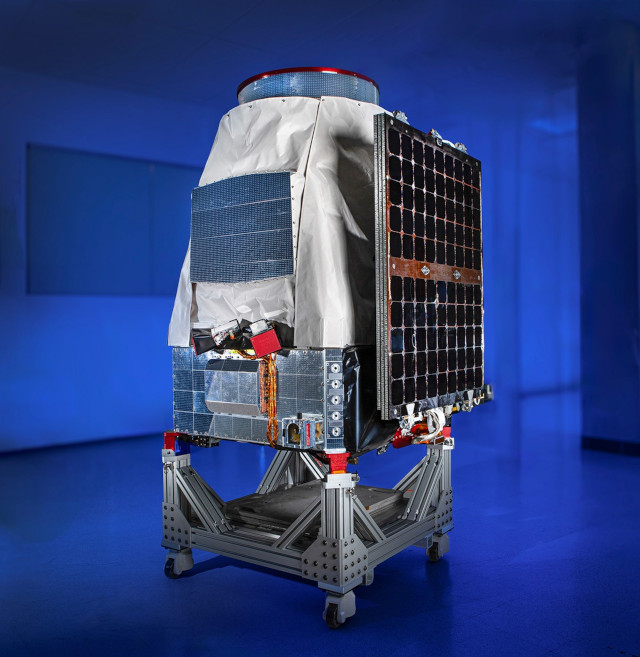
A few hours ago, a Falcon 9 rocket launched from Vandenberg Air Force Base on the Twilight rideshare mission, carrying a total of 40 satellites in various phases. About two hours and twenty minutes after launch, the final group of satellites was deployed by SpaceX’s system. Among them were NASA’s Pandora Space Telescope and the BlackCAT and SPARCS nanosatellites, both 30x20x10-centimeter CubeSat-class satellites, part of NASA’s CubeSat Launch Initiative. These satellites will conduct their astronomical observations from low-Earth orbit.
Part of NASA’s Astrophysics Pioneers program, which develops low-cost astrophysics projects, the Pandora Space Telescope aims to study the atmospheres of exoplanets previously discovered using other instruments. It will conduct its observations at optical and near-infrared frequencies with its 45-centimeter telescope and the detector built as a spare for the James Webb Space Telescope. It will use these instruments to distinguish electromagnetic emissions from an exoplanet from those from its star.
The Pandora Space Telescope’s work will be based on the passages of the exoplanets under study in front of their stars, known as transits. During a transit, starlight passing through the planet’s atmosphere can be detected from Earth. This allows the chemical signatures of the compounds with which that light interacted to be detected through spectroscopic analysis.
The problem is that variations in brightness in various areas of a star’s surface make spectroscopic analysis complex. Furthermore, starlight can already include the chemical signatures of compounds present in some areas of the star’s surface. To address this issue, the Pandora Space Telescope will collect data from the exoplanets under study before, during, and after their transits to compare the results and determine which signatures were actually generated by planetary atmospheres.
The Black Hole Coded Aperture Telescope (BlackCAT) nanosatellite aims to study powerful cosmic explosions such as gamma-ray bursts, particularly those emitted in the early universe, and X-ray emissions from black holes and neutron stars. This instrument will be added to the network monitoring extreme cosmic events.
The Star-Planet Activity Research CubeSat (SPARCS) nanosatellite aims to study low-mass stars by monitoring their emissions during stellar flares in the ultraviolet band. Red dwarfs are the most common stars in the universe, but they can be very active, raising questions about the possibility of planets orbiting them being habitable. Slightly more massive stars, class-K stars, are also of interest, and the planets orbiting them are being studied.
The satellites’ deployment was a success. If their tests are successful, Pandora, BlackCAT, and SPARCS will begin their astronomical missions and provide new information on the objects of their detections.