
An article accepted for publication in the journal “Monthly Notices of the Royal Astronomical Society Letters” reports the detection of a megamaser generated by HATLAS J142935.3–002836, a galaxy undergoing considerable activity due to a galaxy merger that also led to an intense star formation. A team of researchers led by the University of Pretoria, South Africa, used the MeerKAT radio telescope to detect the maser emissions. The strength of its emissions is so high that the researchers called it a gigamaser, but certain detections are only possible thanks to a gravitational lensing phenomenon. This still makes it the brightest and most distant astronomical maser known.
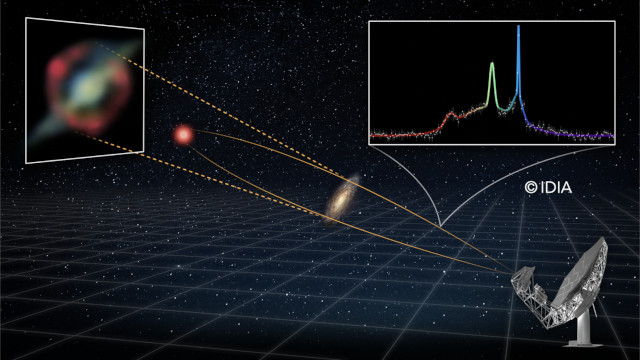
The image (courtesy of the Inter-University Institute for Data-Intensive Astronomy (IDIA), all rights reserved) shows the emission detected from the galaxy HATLAS J142935.3–002836. Between that galaxy and the MeerKAT radio telescope’s antennas, there’s another galaxy that acts as a gravitational lens. At the top are hydroxyl lines in the analysis of the detected radio emissions.
The discovery of the galaxy HATLAS J142935.3–002836 was announced in an article published in the journal “Astronomy & Astrophysics” in 2014. Its discovery was made as part of the H-ATLAS (Herschel Astrophysical Terahertz Large Area Survey), conducted over the past decade using ESA’s Herschel space telescope. A galaxy between Earth and HATLAS J142935.3–002836 acts as a gravitational lens, allowing a number of telescopes to detect it in follow-up observations conducted after its discovery.
The initial study in 2014 highlighted that HATLAS J142935.3–002836 was the result of a galaxy merger we’re seeing before its end. A collision between two galaxies caused the compression of interstellar gas clouds present in the original galaxies, triggering significant star formation.
Despite the power and sensitivity of the ALMA radio telescope, among the instruments used in the 2014 study, only today was it possible to obtain the necessary detections to understand that this galaxy behaves like a cosmic maser. This new result was achieved thanks to MeerKAT, one of the precursors to the SKA (Square Kilometre Array), the next-generation radio telescope that could enter service in 2027.
The HATLAS J142935.3–002836 galaxy is an astronomical source of the type technically called a hydroxyl maser. The possibility that hydroxyl molecules (OH, hence the acronym OHM for this type of galaxy) in space can emit microwaves due to energy sources such as infrared radiation has been known for decades.
Entire galaxies can act as masers, and are sometimes called megamasers when the emissions are very intense. Hydroxyl megamasers are rare, making this discovery even more interesting. In the case of HATLAS J142935.3–002836, the emissions are so intense that the researchers believe it might be a gigamaser.
Dr. Thato Manamela of the University of Pretoria, lead author of this new study, stated that he and his colleagues don’t want to find just one system like HATLAS J142935.3–002836, but hundreds, if not thousands. For this reason, they’re carrying out systematic surveys that may in the future be conducted with the SKA radio telescope as well. The results obtained with MeerKAT are already proving the possibilities of this type of astronomical research.
