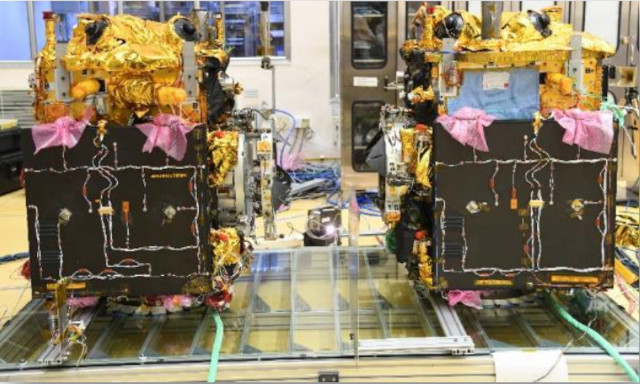
It was night in India when the two satellites of the SpaDeX (Space Docking Experiment) mission were launched from the Satish Dhawan Space Center atop a PSLV-CA rocket. The two satellites separated from the rocket’s final stage and entered a circular orbit at an altitude of about 475 kilometers. Another 24 experiments were launched on the same mission, but the SpaDeX satellites are the most important because they will serve to test the docking technologies necessary for the progress of the Indian space program.
The SpaDeX mission uses two satellites built using a modified IMS-1 (Indian Mini Satellite-1) bus, with the necessary docking hardware and technologies to be tested if the maneuver is successful. The two satellites, called SDX01 or Chaser and SDX02 or Target, have a mass of about 220 kilograms each and are expected to reach a relative distance of about 20 kilometers before starting the series of maneuvers that aim to test the docking maneuver.
To reach the docking, scheduled for around January 7, the Target satellite will use its maneuvering thrusters to reduce its distance from Chaser. The two satellites use a satellite navigation system to determine their relative position and speed, but this use is limited to this phase. That’s because the developments are supposed to lead to Moon missions as well, where it will not be possible to use this type of system.
If the docking maneuver is successful, it will be possible to proceed with the testing of other technologies useful in the event of docking between spacecraft. These are communication systems and energy transfer between vehicles. The two satellites are also equipped with instruments that aim to conduct an extra mission since Chaser is equipped with a high-resolution camera and Target has a camera that operates at visible and near-infrared frequencies to monitor natural resources and vegetation. Target is also equipped with a radiation monitoring system to obtain measurements in its orbit.
After years in which India has exploited decades of experience with weather satellites and launches of various types, including launches on behalf of foreign entities, the national space program has become more ambitious. The rivalry with China, which already has a space station with a regular crew in orbit, has stimulated what is becoming a new space race whose results are yet to be seen.