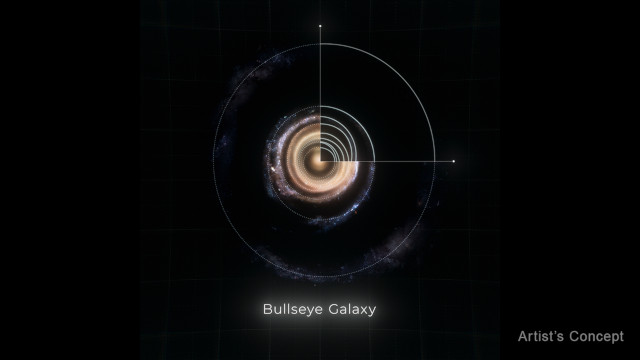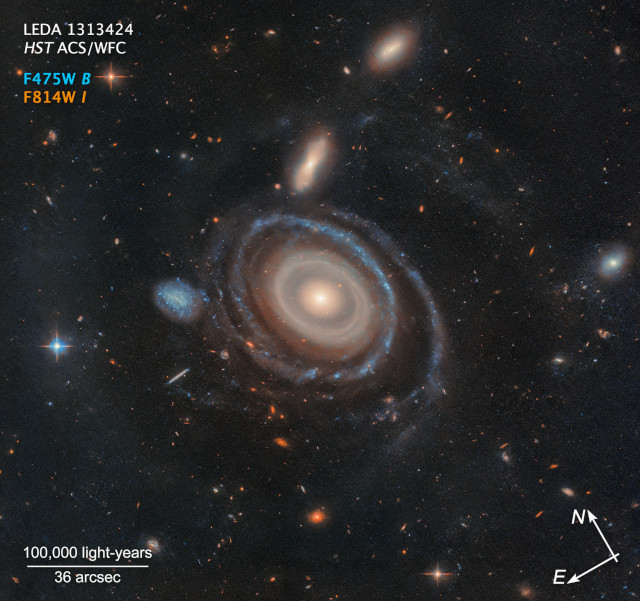
An article published in “The Astrophysical Journal Letters” reports a study of the galaxy LEDA 131342 (Top image NASA, ESA, Imad Pasha (Yale), Pieter van Dokkum (Yale)) that identified nine concentric rings composed of stars that make it look like a sort of cosmic bullseye. A team of researchers used the Hubble Space Telescope and the Keck Observatory in Hawaii to identify these rings that form a truly extraordinary configuration considering that so far, galaxies with only two or three rings were known. The cause of this unique conformation is a dwarf galaxy that, according to calculations, about 50 million years ago passed through LEDA 131342 drastically changing its original shape.
About 567 million light-years away from Earth, the galaxy LEDA 131342 is almost 2.5 times the size of the Milky Way with its diameter of about 250,000 light-years. Discovered in 2019 in the data collected by the Legacy Survey DR9, immediately, it turned out to be interesting because various rings were visible and showed its extraordinary situation.
The consequences of galaxy interactions are well known, but galaxies with two or three rings are already rare. The reason is that the consequences of those interactions lead to a new equilibrium with the outer rings fading away in a relatively short time from an astronomical point of view. This process still takes millions of years, but this means that astronomers must be able to observe a galaxy no more than a few tens of millions of years after the interaction to see multiple rings.
In the case of the galaxy LEDA 131342, according to the researchers, about 50 million years ago a dwarf galaxy passed through its much more massive neighbor, causing radical changes in its internal structure. In its press release, NASA used the analogies of a stone thrown into the water and the Northern Gannet (Morus bassanus), a seabird that dives into the water to catch fish, to explain the effects of that interaction, similar to the ripples that form in the water after an impact.
Imad Pasha, the lead researcher on this study and a doctoral student at Yale University, explained that he was looking at a survey image and was drawn to it when he saw a galaxy with several rings. He and a team of colleagues used the Hubble Space Telescope’s Advanced Camera for Surveys (ACS) instrument to spot eight rings and the Keck Cosmic Web Imager (KCWI) at the Keck Observatory to spot the ninth ring. There may even be a tenth ring, but if it exists, it would be three times farther away than the ninth ring and that means that it’s become so faint that it’s undetectable. The bottom image (NASA, ESA, Ralf Crawford (STScI)) shows the scheme of those rings.
The blue, clumpy dwarf galaxy in the image is the likely culprit in that cosmic collision. Data collected at Keck Observatory revealed gas flowing between this dwarf galaxy and LEDA 131342, a consequence of that ancient passage and the last phase of their interaction.
LEDA 131342 offers a unique opportunity to study a galaxy in a particular phase after an interaction. It’s possible that such an event could cause a galaxy to evolve into a phase called a Low Surface Brightness galaxy, caused by the fact that the rings slowly expand and fade away as they become fainter and fainter.