
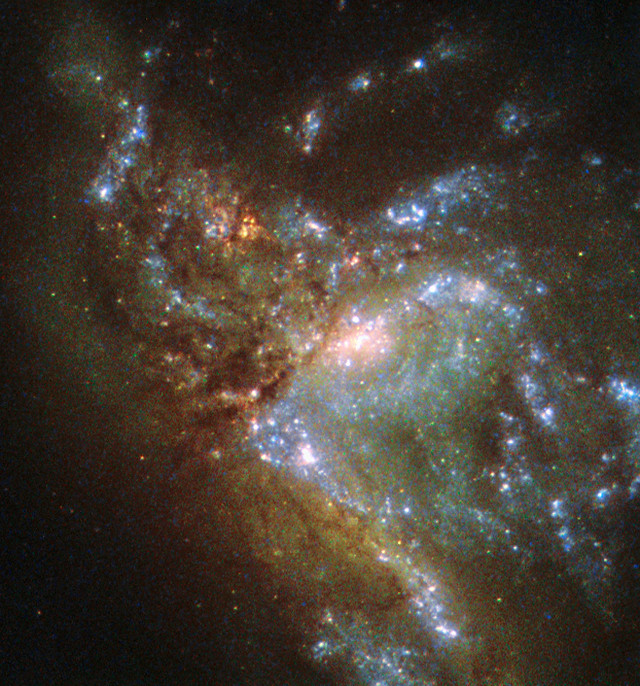
NGC 6052 is a galaxy apparently abnormal because of its odd shape. It was initially classified in that way but later astronomers realized that it’s actually the result of an ongoing merger of two galaxies with similar masses. The Hubble space telescope was used to take a picture of NGC 6052 with its Wide Field Planetary Camera 2 (WFPC2), which includes observations in visible and ultraviolet light.
The galaxy NGC 6052, also known as Mrk 297 or LEDA 57039 or Arp 209, depending on the catalog, is located about 228 million light years from Earth. In the October 1969 issue of the magazine “Publications of the Astronomical Society of the Pacific”, it was described as a galaxy with a rather unusual structure. The photographs taken at the time clearly showed regions of strong emission and irregular appendages on its eastern side.
The perplexity of the astronomers of the time is understandable. Today we know much more about galaxy evolution and astronomers can recognize a merger taking place. A long time ago, two galaxies were attracted toward each other by their force of gravity and the consequence is that their stars started to change their paths in a more or less clear way, depending on their position.
Billions and billions of stars began a kind of dance, pulling at each other with their gravity. A galactic merger can go on for many millions of years and meanwhile the resulting galaxy constantly changes its shape in a chaotic manner. For this reason, NGC 6052 has the strange shape we see today and who knows when it will take its final shape, which could be very different from this one and from that of the two original galaxies.
The appearance of a galaxy during and after a merger depends on many factors, starting from the mass of the mergin galaxies and from their relative position when the collision happens. Each case has its own history so the shape of the galaxy NGC 6052 is different from that of NGC 428, which is also the result of a merger.
In the distant future, the Milky Way will start merging with the Andromeda galaxy to form a single giant galaxy. Unlike NGC 6052, it will be the result of the merger of two galaxies with very different masses and sizes as Andromeda is much bigger than the Milky Way. It will be another spectacular event!
[ad name=”eBayUSUKAstronomy”]
