
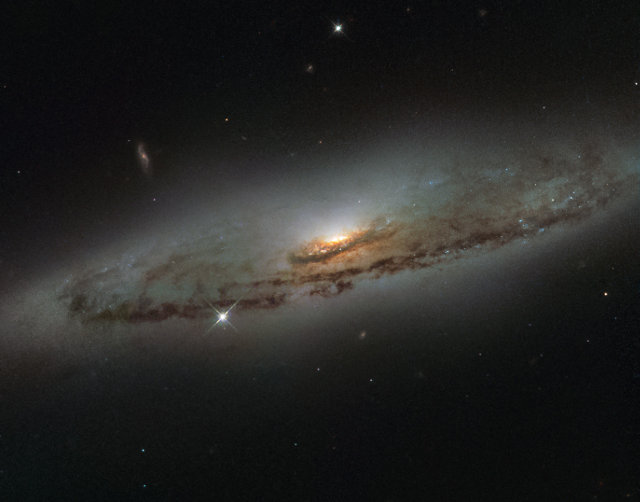
The Hubble Space Telescope took a photograph of the galaxy NGC 4845. At its core, it contains a supermassive black hole, a fact now considered normal but that can be detected only indirectly, through the gravitational effects on stars near to the galactic core. During the observations, it swhoed a remarkable appetite as in 2013 it swallowed in a short time a mass several times that of the planet Jupiter.
The galaxy NGC 4845, also known as UGC 08087, LEDA 44392, 2MASX J12580124+0134320 or NGC 4910, is over 65 million light years away. It’s a spiral galaxy discovered by William Herschel in 1786. It’s nothing extraordinaty but it’s become an interesting object of study following the activity of the supermassive black hole at its center.
Like the galaxy hosting it, the supermassive black hole doesn’t look anything special. It has an estimated mass of about three hundred thousand solar masses but the one at the center of the Milky Way, known as Sagittarius A*, has a mass estimated at around four million solar masses. Because of the distance of the galaxy NGC 4845, it would have become one of the many objects studied just superficially if it hadn’t shown a particularly high activity.
In particular, in early April 2013 it was announced that the ESA’s INTEGRAL (INTErnational Gamma-Ray Astrophysics Laboratory) space telescope had identified a flare from the supermassive black hole in the galaxy NGC 4845. The event was subsequently observed with the ESA’s XMM-Newton space telescope and also from the International Space Station using the experimental Japanese MAXI (Monitor of All-sky X-ray Image) camera.
Putting together the various data, it was determined that the emission of X-rays and gamma rays came from materials around the supermassive black hole that belonged to an object ripped apart and swallowed. The estimate of the mass ended up into the black hole is very approximate as it ranges from 14 to 30 Jupiter masses. It was therefore a super-Jovian planet or a brown dwarf, an object at the boundary between a planet and a star.
Such violent events are not very frequent but in November 2015 a study was published on one of them, called ASASSN-14li, which caused the destruction of a star. Thanks to the event discovered in the galaxy NGC 4845 there has been more attention on it and now we can see another magnificent photograph taken by the Hubble Space Telescope’s Wide Field Planetary Camera 2 (WFPC2). These studies are also useful to better understand the influence of supermassive black holes on the cores of the galaxies that host them.
[ad name=”AmazonScience”]
