 Several scientific organizations have announced the detection of what appears to be an interstellar comet, which has consequently received the designation 3I/ATLAS. It could be a large comet, with an estimated width of around 20 kilometers, but the first estimates of the size of its nucleus are still very rough. Its trajectory will take it within the orbit of Mars, but, together with its considerable speed, it will only lead to a limited direction change by the Sun’s gravity. Unfortunately, it will never get close enough to Earth to allow detailed observations, but any interstellar object is very interesting for astronomers. This is the third officially recognized “visitor” after 1I/ʻOumuamua in 2017 and 2I/Borisov in 2019.
The image (Courtesy Darryl Z. Seligman et al.) shows at the center the interstellar comet 3I/ATLAS spotted on July 2 by the Canada-France-Hawaii Telescope (CFHT). It’s included in an article describing its discovery and a preliminary description.
On July 1, this comet was spotted by a telescope of NASA-funded ATLAS (Asteroid Terrestrial-impact Last Alert System) project, which aims to identify asteroids, especially if potentially dangerous. In this case, of the four ATLAS telescopes, it was the one in Chile that discovered it. Initially, it was considered an asteroid with the temporary designation A11pl3Z.
After the first report on this object, more information was found from archives of other telescopes showing it in the previous days, up to June 14. The information collected allowed to immediately start calculating its trajectory, which was found to be hyperbolic with a very high eccentricity. This is a clear indicator of an object that doesn’t orbit the Sun but has come from outside the solar system and will leave it.
Another important element in collecting information on this new interstellar object is its nature. Initially, it seemed to be an asteroid, but the quick collection of observations by different instruments proved to be valuable also because some of them detected a faint coma that indicates cometary activity. For this reason, it was designated as the non-periodic comet C/2025 N1 (ATLAS). In the registry of interstellar objects, it was designated as 3I/ATLAS.
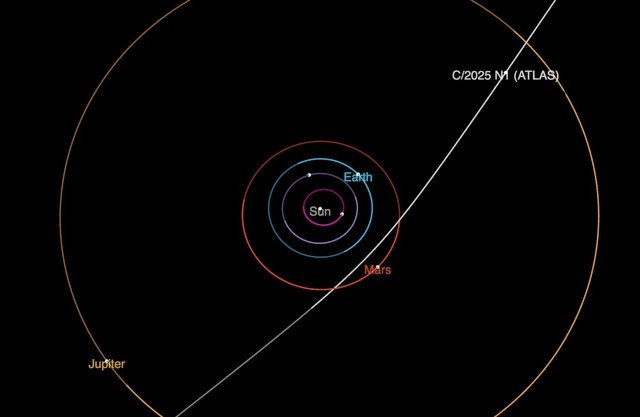
At this time, interstellar comet 3I/ATLAS is just inside the orbit of the planet Jupiter, about 670 million kilometers from the Sun. Astronomers have estimated that it will reach aphelion, its closest point to the Sun, around October 30, when it will be just inside the orbit of the planet Mars, about 210 million kilometers from the Sun. The image below (NASA/JPL-Caltech) shows the projected trajectory of interstellar comet 3I/ATLAS.
Estimates of the size of the nucleus of interstellar comet 3I/ATLAS are rough. It appears to be a large comet with estimates of up to a width of 20 kilometers, but the coma makes it difficult to distinguish the nucleus, which could be much smaller.
Observations of interstellar comet 3I/ATLAS from Earth will continue until September because at that point, it will pass too close to the Sun from the Earth’s perspective to continue to be visible. It’s expected to reappear on the other side of the Sun in early December. Observation conditions will remain unfavorable, but any observation of an interstellar object can provide interesting information for astronomers.