
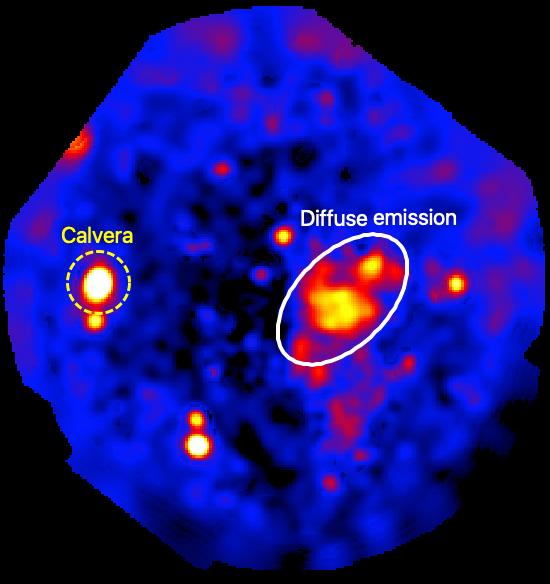
An article published in the journal “Astronomy & Astrophysics” describes a candidate supernova remnant that was associated with the pulsar nicknamed Calvera. A team of researchers from the Italian National Institute for Astrophysics (INAF) and the University of Palermo, led by Emanuele Greco of INAF, conducted observations and analyses of a decidedly unusual pair, as finding it approximately 6,500 light-years above the Milky Way’s galactic plane was surprising.
The image (Courtesy E. Greco / INAF) shows the Calvera pulsar and the diffuse emission region object of this study, seen in X-rays.
Because of its surprising location, various observations were conducted with different instruments in the years following the discovery of Calvera. The conclusions now link the candidate supernova remnant cataloged as G118.4+37.0 to the pulsar, which is moving away from the area where it formed.
INAF had already participated in a study of the Calvera pulsar, published in “The Astrophysical Journal” in December 2021. In early 2022, the LOFAR (Low Frequency Array) radio telescope in the Netherlands detected, with its 51 antennas, a structure with characteristics associated with a supernova remnant. It was detected far from the galactic plane, a few arcminutes away from Calvera, so it could be the site where a massive star exploded in a supernova and the remaining core collapsed into a neutron star.
Emanuele Greco’s team used observations conducted with ESA’s XMM-Newton space telescope. The gas within what appears to be a supernova remnant is hot enough to emit the detected X-rays. The researchers also used other observations to obtain a more complete portrait: gamma rays detected by the Fermi space telescope and visible-light emissions detected by the Galileo National Telescope.
The collected data were combined to reveal the different characteristics of the supernova remnant’s diffuse structures and to perform an analysis. The results indicate that the supernova remnant is located between 13,000 and 16,500 light-years from Earth and has an age between 10,000 and 20,000 years. These estimates are compatible with those of the Calvera pulsar, suggesting that it was born from that supernova and then moved away.
The interest in the Calvera pulsar and its origin is due to the fact that stars massive enough to explode as supernovae form almost exclusively in the galactic plane, as the gas density in that area is sufficient to favor this formation. For this reason, its traces aren’t expected to be found so far from the galactic plane. The gamma-ray emissions detected are also surprising because astronomers believe a certain particle density is needed to activate one of the main mechanisms that produce them.
The portrait obtained from multi-wavelength observations of the supernova remnant is complex, and follow-up studies could yield many more insights. It’s still unclear whether the progenitor star was a so-called runaway star that arrived from the galactic plane or whether it formed in the area where the supernova remnant now resides. Mapping that area could reveal the history of an unusual massive star that exploded far from the galactic plane, generating the Calvera pulsar.
