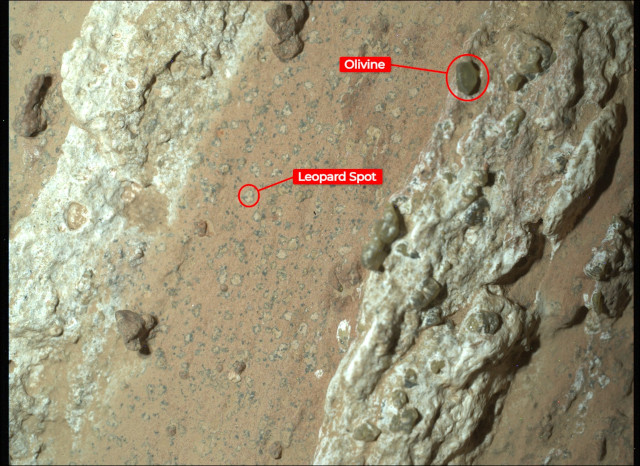
An article published in the journal “Nature” reports the results of the analysis of data collected by NASA’s Mars Rover Perseverance on the rock nicknamed Cheyava Falls. Perseverance found it in 2024 in the Neretva Valley during its journey within the Jezero Crater on Mars. The rock immediately attracted great interest because it contains chemical signatures and structures that could have been generated by ancient Martian life forms.
A team of researchers confirmed the exciting results presented last year and concluded that these are potential biosignatures. This means they provide clues to the possible presence of Martian life forms in the past, but further studies are needed to obtain definitive answers. In fact, the presence of organic compounds and iron minerals such as vivianite and greigite could also be due to abiotic reactions.
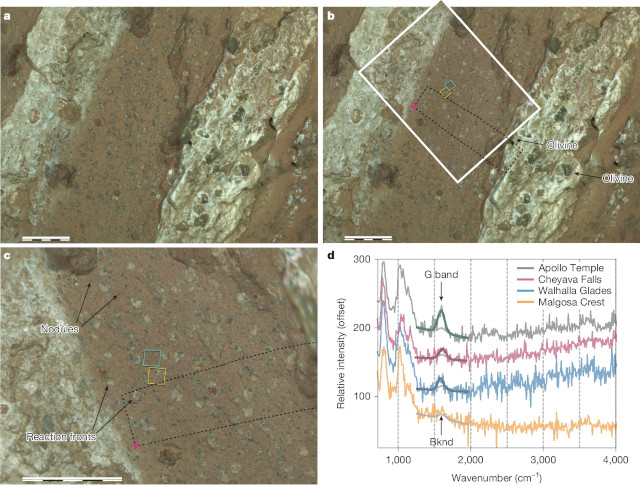
The image above (NASA/JPL-Caltech/MSSS) shows views of the rock Cheyava Falls with spectroscopic results (d) from the examination of samples from the area.
The story of the Cheyava Falls rock begins in July 2024, with the collection of a sample by the Mars Rover Perseverance. The presence of organic compounds is very interesting, but abiotic chemical reactions can create them. There are cases where the presence of certain compounds on Mars can be explained without the need for life forms, but other cases have emerged where finding an alternative explanation, other than biological activity, is more difficult.
On Earth, vivianite is, among other things, a compound that replaces organic material in fossil bones. Greigite is produced by some Earth’s microorganisms. These minerals can form through geological processes but require high temperatures and acidic conditions, of which there are no traces in the Neretva Valley. However, both these minerals and organic compounds are found in the same location on Mars.
The presence of various compounds that are associated with biological reactions on Earth in the same location on Mars makes this discovery very intriguing. For this very reason, NASA presented the results of this study in a teleconference. There’s excitement but also great caution, because the hope of finding traces of extraterrestrial life cannot interfere with serious scientific research. Indeed, such an exceptional hypothesis requires solid proof to be confirmed.
The study’s authors confirmed the need for in-depth analyses, but it would be necessary to return some samples collected by the Mars Rover Perseverance to Earth. During the teleconference, NASA Acting Administrator Sean Duffy discussed the Mars Sample Return mission, a collaborative project with the ESA, stating that the costs and funding required are currently being analyzed. At the moment, the project appears to be stalled, partly because the costs appear to be very high.
The Mars Rover Perseverance’s journey continues, also in search of other rocks potentially interesting from an astrobiological perspective. Each new discovery could stimulate interest in developing a mission to return samples to Earth.