
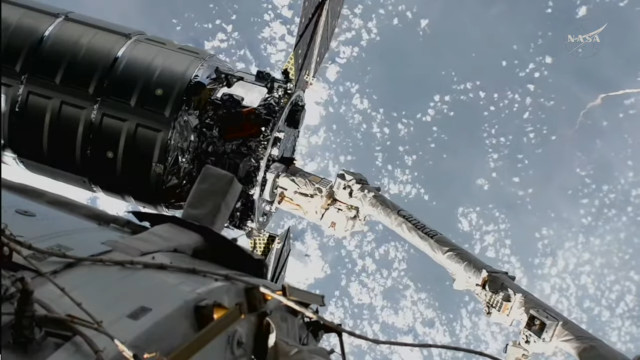
Northrop Grumman’s Cygnus XL spacecraft, launched last Monday, September 15, has just reached the International Space Station and was captured by the Canadarm2 robotic arm. Astronaut Jonny Kim, assisted by his colleague Zena Cardman, will soon begin the slow maneuver to move the Cygnus until it docks with the Station’s Unity module after about two hours.
The S.S. William “Willie” C. McCool cargo spacecraft arrived a day late due to a problem encountered during one of the maneuvers needed to raise the Cygnus XL cargo ship’s orbit to reach the International Space Station. The onboard computer shut down the main engine earlier than planned during two burns for reasons that will be analyzed in depth. The computer is programmed to have safety as its top priority, so engineers will look for the reasons that triggered such a measure during those two burns.
After assessing the situation, NASA and Northrop Grumman engineers developed an alternative strategy to put the Cygnus XL spacecraft on the correct trajectory to reach the International Space Station. This intensive effort allowed the journey to end with just a one-day delay.
Tomorrow, the International Space Station crew is scheduled to open the Cygnus spacecraft’s hatch, and at that point, the cargo will be slowly brought to the Station. The NG-23 mission is almost accomplished because the Cygnus spacecraft can’t land, and when it comes back into Earth’s atmosphere, it will disintegrate. For this reason, it will be used to get rid of components that failed or that can’t be used any longer on the International Space Station: all of that will be loaded on the Cygnus and will disintegrate along with it.
The Cygnus called S.S. S.S. William “Willie” C. McCool is scheduled to leave the International Space Station in March 2026. In these cases, a tentative date is decided for the departure of a cargo spacecraft, which, however, can be modified because it also depends on other tasks with higher priority.
Northrop Grumman’s plans for its next resupply mission are more sketchy than ever. Mission NG-22 was postponed to a date yet to be established due to damage sustained by the cargo spacecraft during transport to Cape Canaveral. It’s possible that in the end, the company and NASA will proceed with mission NG-24 first.
